
Starting afresh: How Teachable rebuilt their customer experience and operations with Fin
With 100,000 creators and nearly 40 million students worldwide, Teachable’s customer service team was under growing pressure. It got to a point where the team was reaching capacity and could no longer deliver a great experience for both creators and students.
“Everything was coming in with a seeming equal urgency,” says Kathleen Ross, Associate Director of Product Support at Teachable. “We had to make decisions about whether we support our creators or the students first. But our students are our creators’ customers, so we wanted to make sure they have a good experience too.”
For years, support ran through a Zendesk setup that had accumulated forms, automations, and workflows for almost every kind of request. Over time, that made the operation harder for the team to run, and frustrating for customers, who had to choose the right form and figure out which category their question fell into before they could get help.
Teachable knew AI could help them scale, but they didn’t want to just bolt it onto their existing legacy structure. They decided to start afresh, with Intercom, an AI-powered helpdesk, serving as the foundation of their support operation and Fin, the AI Customer Agent, taking over the first line of support.
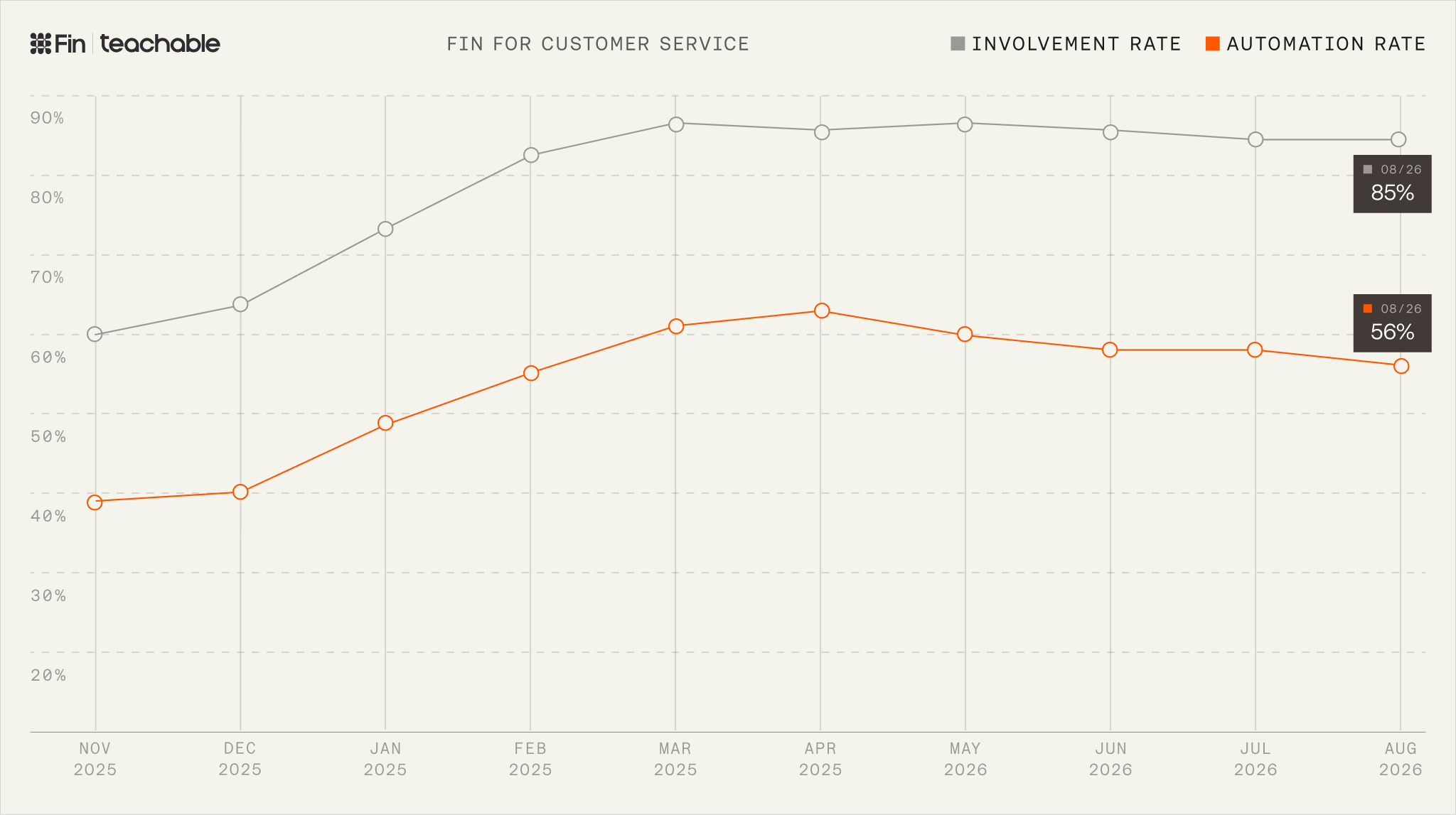
Today, Fin is involved in 85% of conversations and resolves 68% of queries it touches end to end, supporting creators and students around the clock. And Teachable is now bringing that same AI-first approach to how they run support behind the scenes.
Here’s their story.
Teachable helps creators turn their skills and knowledge into businesses through online courses, coaching, and digital downloads. Because they operate a marketplace, they support both the creators building the businesses and the students who learn from them. That makes for a uniquely complex support model, with questions from both groups landing on the same small team. As they grew, the support team faced two main challenges:
1. Giving creators and students an equally great experience
Every new creator brings with them hundreds, if not thousands, of new students, multiplying the questions coming into support. And because the two audiences have different needs, they need very different kinds of help. Creators have queries about billing, payouts, tax setup, and troubleshooting their schools, and students need help logging in, accessing courses, using the mobile app, and resolving payments.
 “Sometimes we’d just send students back to a help doc or back to their school. But we really wanted to give everyone a great experience.”
“Teachable is a complex product. And because we’re serving both creators and students, we were getting a lot of questions,” says Kathleen. “We have 12 support agents, and we couldn’t keep pace with the growing volume. Sometimes we’d just send students back to a help doc or back to their school. But we really wanted to give everyone a great experience.”
2. A rigid support setup
The team’s support setup added to the complexity. After years on Zendesk, Teachable had accumulated layers of legacy forms, automations, and workflows for almost every kind of request. “There was a form for everything,” Kathleen recalls. “We had to set one up for every kind of question so each request could be routed to the right place. That put the burden on customers, and it wasn’t the experience we wanted to provide.”
The setup created friction for the team too. Maintaining a growing web of forms and automations was time-consuming, and made support harder to manage and slower to change as the business evolved.
Teachable was ready for what Kathleen calls “a clean start.” So they went in search of a new helpdesk and an AI agent that could help them scale.
When Teachable started looking at new platforms, they saw a chance to completely rebuild how they ran support. “We were looking for a platform where AI was the starting point, not a feature,” says Kathleen. “We didn’t want to tack AI onto our existing support system. We wanted to start with it and build the whole experience around it.” That led them to Intercom and Fin.
Moving to Intercom gave the team an opportunity to go back to first principles and rethink how they delivered support. They revisited their SLAs and the way urgent tickets flow in, and replaced the maze of forms with a simpler experience where customers are able to just ask a question.
With the foundation in place, the next step was to roll out Fin. The team named the agent Sunny, inspired by Teachable’s lemon-colored brand, and trained it on their help center. “We wanted our AI agent to feel friendly and warm,” shares Kathleen. “Giving it a name and a bit of personality made it feel more natural for customers to interact with.”
Once live, Fin quickly proved its capabilities, immediately resolving 35% of support volume using Teachable’s help center knowledge.
Fin’s strong performance from early on gave the Teachable team confidence to take it further.
Expanding to more complex work
The team connected Fin to Retool, a tool Teachable uses to work with account data, and its staff app, giving Fin access to relevant account context and the schools associated with each customer. Using these tools, Fin is able to answer highly account-specific questions, like explaining which plan a customer is on and what features are available to them.
“We’ve moved way past FAQ deflection,” says Kathleen. “Fin can now handle questions with a level of context and complexity that goes far beyond a typical AI bot.”
The team also set Fin up to handle multi-step work that would previously have needed a human to be involved. For example, when someone asks for their account to be deleted, Fin sends a one-time passcode to verify the customer’s identity and looks up every Teachable account tied to their email. Then, it shares the list of accounts with the customer and, once they confirm, Fin triggers the deletion workflow in Teachable’s backend.
Proactively helping customers
As Fin took on more of Teachable’s incoming support, the team had more capacity to develop ways of supporting customers before they even opened a ticket. They connected Fin to Pendo, which gave it behavioral and page context in real time so they could offer proactive support while customers were on the page. “Because Fin receives context from Pendo, customers now get help on the page where they’re stuck, right when they need it,” shares Kathleen.
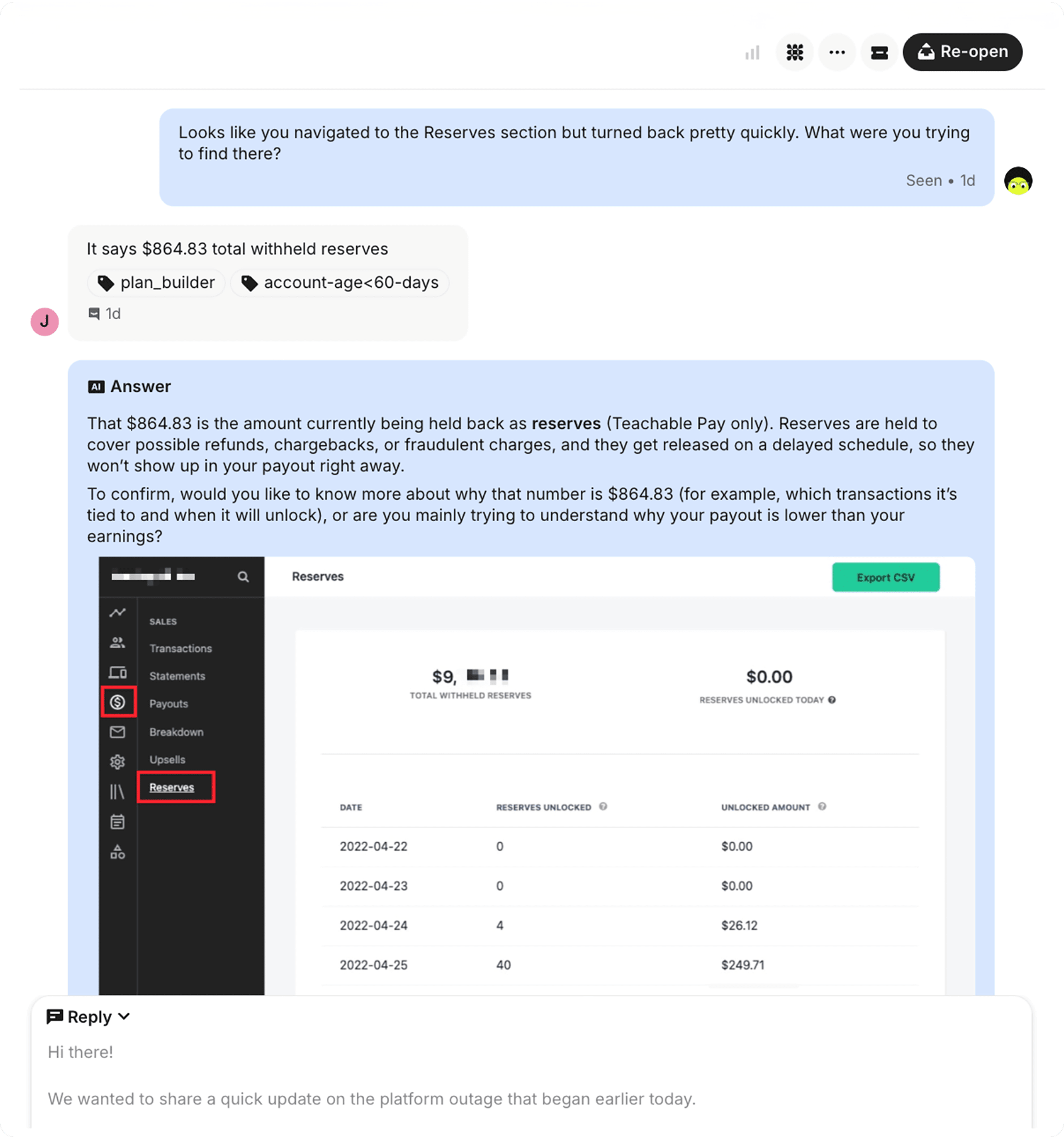
This has proved especially valuable in time-sensitive or critical moments. “When money is involved, even expected product behavior can feel like something’s wrong,” Kathleen explains. “Fin now sees when a creator is looking at their reserve balance, proactively explains why part of their payout is being held and when it will be released.”

Using AI to run operations
Kathleen then extended that same AI-first approach beyond customer interactions to the way the team manages support behind the scenes. They began using Operator, an agent that helps teams using Fin run customer operations. “Operator helps us monitor the customer experience in real time, see exactly where customers are getting stuck, and suggest fixes,” says Kathleen. “That lets us catch friction before it becomes a bigger customer issue.”
One of the clearest examples came when Teachable moved its payments infrastructure from a custom-built system to Stripe. A change of that scale would normally have meant reviewing hundreds of help center articles by hand and searching for every “payments” reference. Instead, Kathleen put Operator to work: “I essentially gave it our entire internal document on the change. It built a support readiness plan, showed us which content and workflows needed updating, and told us where to focus first. It didn’t just point out what was wrong; it helped us fix it.”
As the migration rolled out, Operator helped the team automatically surface confusing conversations and pinpoint where customers were getting stuck. That tightened the feedback loop between spotting an issue and fixing it, helping the team act before small points of friction became bigger problems.
Today, Fin is involved in 85% of conversations and resolves 68% of the queries it touches. That means 56% of Teachable’s total support volume is now automated by Fin end to end. The team no longer has to decide whether to support creators or students first because Fin has helped provide both groups with high-quality help around the clock. And with the proactive outreach they've set up, customers now often get help before they even ask.
“Customers now get help on the page where they’re stuck, right when they need it, and that’s reflected in an average CX Score of 4.1 out of 5 and the feedback they leave,” shares Kathleen. One creator who ran into a problem late at night worked through it with Fin and ended the conversation by saying, “Thank you so much for being here. Now I will sleep better.” Another customer wrote, “Thank you so much, Sunny. You are an amazing, patient, and kind customer support person.”
As Fin has taken on more of the workload, it has changed how Teachable’s human team works too. The conversations that reach them now are the ones that benefit most from human expertise: edge cases, unexpected behavior, and genuine bugs. Any conversation that Fin hands over includes details like screenshots and browser information to ensure human agents have the context they need to pick up where Fin left off, saving them hours of troubleshooting.
The team now puts that time into improving the wider customer experience and the support operation behind it. And Operator makes that work easier too. “Operator has given us so much more insight into our support operation in such a short period of time,” says Kathleen. “For a small team, that makes a huge difference.”
So when Kathleen made the case for growing the team, she could focus on deeper expertise rather than simply adding more people to keep pace with volume. “We’re not just looking for more bodies to throw on volume,” she says. “We’re looking for targeted technical support that experienced agents can provide. And that was a story senior leadership could really hear.”
By bringing AI into both front-line support and operations, the team has gained the confidence they need to let Fin take action in their systems – something Kathleen is excited to build out.
“With the controls built into Fin, we can be precise about how it should act. That gives us the confidence to automate more of the process, and that’s what we’re excited to do next.”The team is setting up Stripe-connected workflows that will allow Fin to move from explaining a policy to acting on it, such as looking up a creator’s next payout and processing an eligible refund directly in the conversation. “Refunds are complex because every creator can set their own policy,” says Kathleen. “But with the controls built into Fin, we can be precise about how it should act. That gives us the confidence to automate more of the process, and that’s what we’re excited to do next.”