
How a Super Bowl support crisis led Kalshi to rebuild their stack on Fin
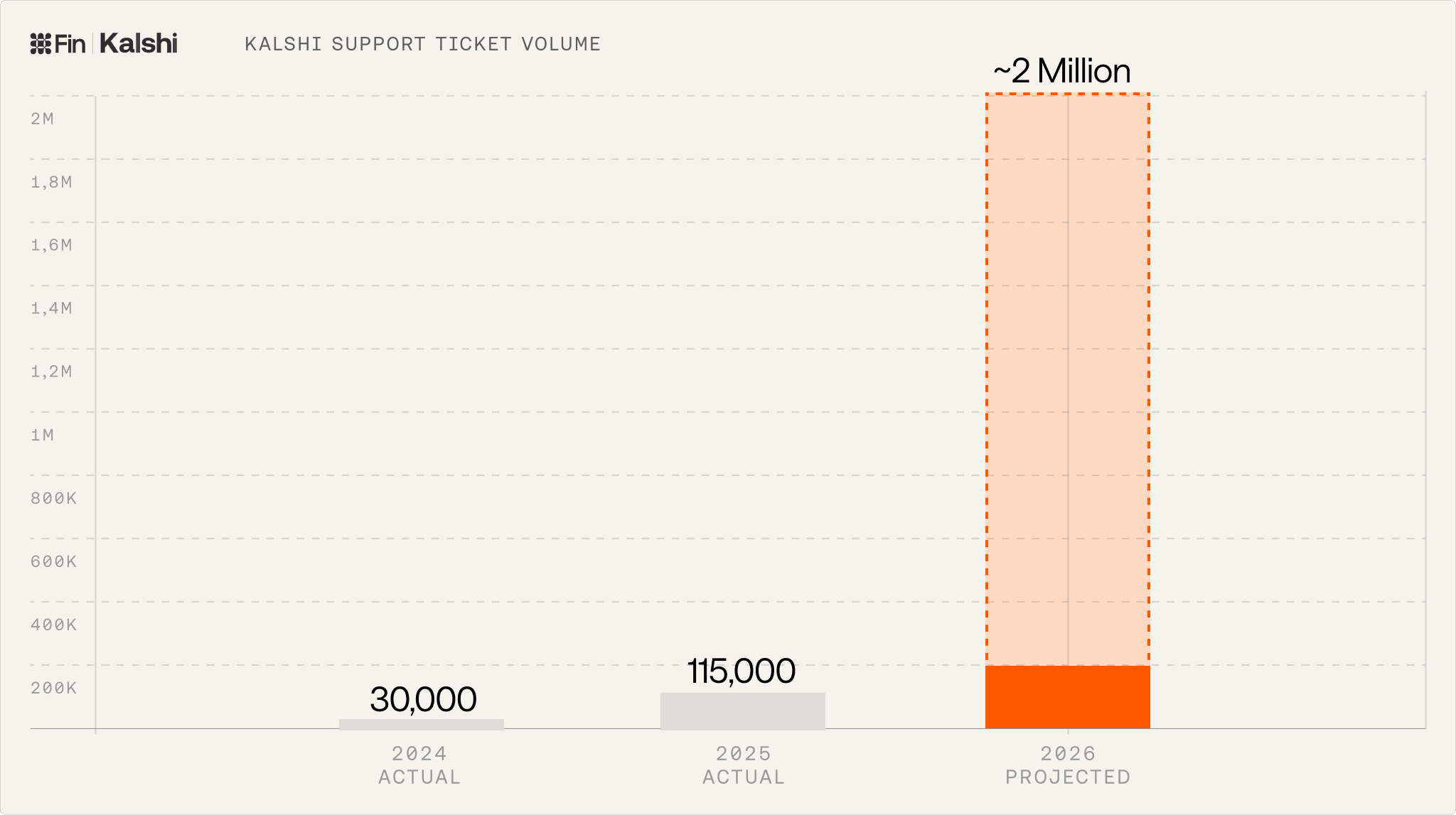
Kalshi is the first federally regulated prediction market exchange in the United States, where people trade contracts on real-world events from elections to the weather. As prediction markets grew in popularity, Kalshi’s support volume climbed rapidly, growing from 30,000 tickets in 2024 to a projected two million by the end of 2026.
Recognizing that they needed to scale, but not wanting to give up the small team’s close-knit culture, Shannon Magiera, Operations Lead at Kalshi, brought in Fin, an AI customer agent, to handle front-line support queries on top of the team’s existing helpdesk.
Within weeks of going live with Fin, Super Bowl LX happened. The rush of sign-ups, deposits, and trading drove support volume to record highs, and while Fin held up, the team’s existing platform beneath it did not. That failure led Kalshi to go all-in with Fin and move their entire helpdesk over to Intercom.
Since this migration, the team has seen incredible results. Fin is now involved in nearly every support conversation and resolves around 80% of them end to end, without a human stepping in. As a result, Kalshi’s resolution time has fallen from around 23 hours to just a few short minutes. Beyond the numbers, the team has won back time to not only engage with their customers more meaningfully, but also to enjoy their personal lives. “I get to eat dinner with my family again,” Shannon shares, “because Intercom and Fin have given us room to breathe.”
Here’s how their hardest weekend of the year led to Kalshi’s small team completely rebuilding support and setting themselves up for success in the long term.
By January 2026, Kalshi had become one of the fastest-growing companies in fintech. Their support team was tiny, with just six people handling an ever-increasing volume of tickets – 30,000 in 2024, 115,000 in 2025, and a projected two million in 2026.
To provide support, the team relied exclusively on email and macros. There was no real-time chat. Conversations that appeared to be a chat window in the app arrived as emails on Kalshi’s side. The team would reply, mark the ticket resolved, and move on, but the queue was so deep that at times getting back to customers could take the better part of a week.
Shannon is blunt about what that looked like: “We had to rely on macros for everything. Everything was pre-written language that may or may not actually solve the customer’s problem.” As a “support operations” team, the work went way beyond just answering customer questions. Everyone was hands-on with filing bug reports, flagging market issues, coordinating with engineers and product managers, and feeding insights back to the rest of the company. With so much on the go, Shannon knew they needed to scale, but she worried that adding headcount meant they’d lose this operational depth and their close-knit culture.
“We didn’t want to turn into a 200-person call center. That just doesn’t align with Kalshi’s values and our company mantra,” Shannon explains.
AI was an obvious solution, but their previous platform’s built-in AI tools hadn’t helped, and another AI agent they tested was pulled before going live with it. In their market, every answer an AI gives a customer carries regulatory weight, so an agent that can be manipulated or invents answers is a liability Kalshi could not take on.
“We have been very wary of putting AI in place to handle support inquiries because we are in this regulated area. We have to be very careful about what we’re saying to our customers,” says Catherine Sullivan, Kalshi’s founding Product Manager.
Despite the two false starts, Shannon remained convinced that finding the right AI was the way forward.
Three weeks before the Super Bowl LX kicked off, the team reached out to Fin. “It was an instant connection. They matched my energy,” recalls Shannon.
Recognizing that the Super Bowl would bring with it the biggest demand spikes of the year with a tidal wave of new sign-ups, deposits, and trades, it was all hands on deck. Within a day of their first call, Shannon and her colleagues were deep in an evaluation, meeting with the Fin team almost daily to work out what it would take to get Fin up and running.
They started by importing Kalshi’s help center and running batch tests, which delivered promising early results. Then came the harder, more important work of shaping rules for what terms Fin could and could not use, topics it had to escalate on sight, and how it should handle financial questions without straying into anything resembling endorsement or advice. This was exactly where the previous vendor had come undone.
Fin underwent rigorous testing, with Kalshi’s legal and compliance teams stress-testing every guardrail, probing for the manipulation that had sunk the previous vendor. When a tester asked Fin to talk like a pirate, it refused on its own, with no rule the team had needed to write. Fin passed, and for the first time the team trusted what they were about to put in front of their customers.
Roughly 10 days after that first call, Fin was live on 100% of production traffic, layered on top of the helpdesk platform Kalshi was still using at the time.
The results were instant. Three days out from the big game, Fin was already resolving 69% of the conversations it was involved in, giving the team a huge sense of relief and reassurance as they approached the biggest weekend in their history.
When Super Bowl Sunday arrived, 80,000 support tickets came flooding in within 24 hours.
As Kalshi’s traffic spiked to record levels, the API rate limits on their helpdesk platform kicked in, causing it to cap requests and block Fin and the human team from operating. The Fin team stayed on through the weekend, working alongside Kalshi through the fallout, but because of the underlying helpdesk’s failure, support essentially went dark for 48 hours.
 “We move quickly. We are grinding 24/7, and I need our partners to grind right there with me. And the Fin team did.”
In a live, real-time market, a two-day response time is meaningless because the game is over and the moment has passed. Users who needed help with a deposit, or a position during the game had already moved on by the time the team could reply.
“We had the fastest-growing company in the world at that moment. There was the potential for millions of dollars and we were just leaving it on the table,” Shannon recalls. “We had thousands of tickets flowing in constantly and couldn’t respond to any of them until two days later.”
The experience crystallized something Shannon had been considering.
“At the time, I was angry. That was my initial knee-jerk reaction,” she says. “And then it was just immediate clarity: we need to take this in another direction. It was time to blow everything up and start from scratch.” Kalshi made the call to migrate their entire support function to Fin's own AI-powered helpdesk, Intercom.
Moving over was about more than just avoiding another rate-limit incident. Shannon was looking for a partner that matched the way her team worked and the speed they moved at. “We move quickly. We are grinding 24/7, and I need our partners to grind right there with me,” she says. “And the Fin team did.”
In less than three weeks, the team executed the full cutover to Intercom. Fin, the Messenger, workflows, and email routing were all live on the Intercom platform. “We would not have been able to do this kind of sprint with any other company,” Shannon remarks.
Working as part of a holistic system, Fin does more than answer FAQs. With integrated access, Fin can answer personalized questions with real context by pulling from a user’s account information. For example, when someone asks “where is my money?” Fin looks up their specific account, checks whether a market is still open, pending settlement, or already settled, distinguishes between deposit holds and withdrawal processing, and gives a contextually accurate answer with dates and amounts.
Seeing Fin handle complexity so seamlessly built up the team’s trust in what it can do. When they first deployed it, fraud investigations, compliance cases, and account restrictions were kept entirely out of Fin’s reach. Now, these are areas the team is actively bringing Fin into. For these higher-stakes flows, Fin calls an internal Kalshi system that runs the investigation, processes the account data, and feeds the result back. Fin acts as the orchestration layer connecting to Kalshi’s own infrastructure inside an environment where every answer carries real regulatory weight, with guardrails and routing ensuring Fin hands off what it genuinely shouldn’t touch.
With Fin taking on more work, the team’s roles have changed too. Tim McAuliffe is now a full-time “Fin engineer,” focused on building and maintaining the AI operation, while Shannon has doubled down on tracking metrics, filling knowledge gaps, and mapping the broader operational strategy.
"Honestly, it's the most exciting our jobs have ever been,” Shannon remarks. “We've grown right alongside Fin, and everyone on the team gets to wear more hats and think bigger than we ever could when we were just clearing a queue."
Five months after the first call with the Fin team, Kalshi’s support operation bears no resemblance to the one that buckled under the Super Bowl traffic.
They’re still a small team, with five people on the frontline, Shannon focused on metrics, and Tim building the AI operation, but now, with Fin on board, they confidently handle a volume trajectory that would traditionally demand dozens of reps.
“Every other company out there scales to 200+ in support. We are the exact opposite. We’re one of the smallest teams in the company, but we’re working really hard. We’re living proof that that’s possible,” Shannon says.
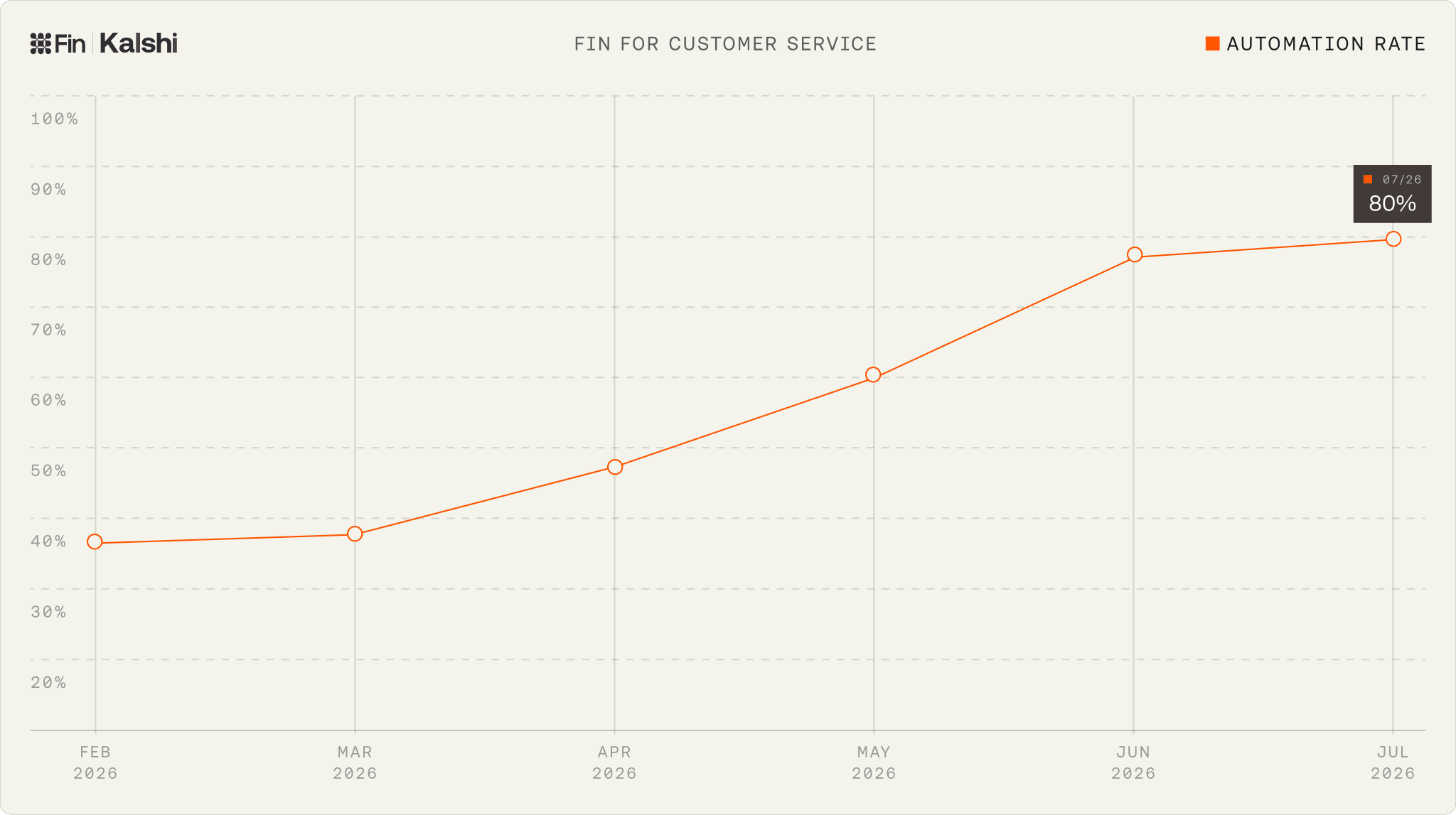
Ninety to ninety-five percent of conversations come in through live chat, and Fin resolves around 80% of these (more than 80,000 every month) on its own, cutting median resolution time from roughly 23 hours to just minutes. Now, only about one in five conversations reaches a human, and the team has time to give these tickets real attention.
“The things that do get escalated, we get to sit down and actually have a conversation with these people,” Shannon says. And she estimates that half of these escalations aren’t even Fin failures – they’re users who didn’t like a correct answer. If a market didn’t settle in their favor or a refund request doesn’t qualify and the answer is “no,” some people want to hear it from a person. “Having Fin onboard has helped bring back humanity in support,” Shannon shares.
With more time available, they’ve got to a point where they’re on first-name basis with users who come back and say thank you. They’re also finding new ways to connect and have started running trader happy hours, where they invite platform users to eat, drink, and share suggestions on how they can make things better. “You don’t have to sacrifice yourself, your business, or your culture,” Shannon reflects. “Intercom and Fin have given us room to breathe.”
Shannon’s team is excited to push their automation further. “What we’re looking for is 100% automation, 100% resolution,” she says. “Obviously there’s always going to be a subset of users who want to speak to a human, and we love that. But if you can automate as much as possible, why not set ambitious goals?”
The next phase of deployment will deepen Fin’s role in account restrictions, fraud, and risk operations, with more sophisticated Procedures and a tighter integration with Kalshi’s internal systems. Shannon also plans to lean on Fin’s AI reporting to investigate dips in customer satisfaction, by surfacing patterns and drilling into their root causes.
Beyond support, Kalshi expects to extend the same AI-first model into new channels and geographies as it expands internationally, with options like WhatsApp and Discord on the table.
The roadmap keeps growing, but the measure of success that the team started with hasn’t changed. When the Fin team first asked Shannon what winning looked like, she said, “Getting to eat dinner with my family.” Now, that’s simply part of her everyday routine.
“I look back at where we were and where we are now,” she says. “That’s a bigger impact than any number.”