
At a glance
Anthropic is an AI research company that focuses on building safe, reliable artificial intelligence that’s aligned with human values.
Anthropic’s support team started with just one person trying to keep up. Today, it’s an AI-first operation where AI resolves 63% of conversations, specialists focus on high-value issues, and new capabilities are delivered without adding headcount.
This didn’t just happen. Instead, the transformation developed through the establishment of clear roles and strong systems, as well as a commitment to continuously improving how the team works and delivers support.
“We know that an AI-native strategy will always outperform an AI-added strategy. That’s why we’ve been so excited to build Fin into our workflows and prove it can make a big impact in support operations,” Isabel Larrow, Anthropic’s first support ops hire remarks.
Here’s how she turned early AI success into a support model built for the new era of automation, scale, and customer expectations.
Laying the foundations for success
Anthropic is one of the world’s leading AI research companies, known for building Claude, their conversational AI assistant. Its users range from free consumers to enterprise API customers – each with different needs, expectations, and levels of technical complexity.
In the early days, Isabel was managing all of it. “I was just trying to survive. Volume was growing fast, and I was making constant trade-offs,” Isabel recalls. “We knew AI was coming, and we knew it was coming quickly. So it was very important to us to ensure we were building support in a way that was scalable, using AI as a foundation.”
In 2024, they selected Fin, an AI customer agent, after a focused evaluation – choosing to implement rather than build in-house. Read the full story behind that decision here.
We knew Fin wouldn’t succeed in a vacuum. It needed to be part of how we worked – not a layer on top.
The early rollout showed strong success signals. “We saw Fin performing really, really well off the bat – taking on nearly half of our conversations and resolving a large share of them from day one,” Isabel shares. But Isabel didn’t see this as a solved problem. She saw it as a foundation that she could continue to build on.
“We knew Fin wouldn’t succeed in a vacuum,” Isabel says. “It needed to be part of how we worked – not a layer on top.” So, instead of just managing AI’s performance in an ad-hoc way, Isabel treated it like a system and focused on building real structure around Fin’s answer quality, content coverage, conversation tagging and review loops.
The operator’s playbook
With the foundations in place, Isabel shifted focus from early performance to long-term scale.
Again, she didn’t treat Fin like a tool to monitor – she treated it like a system to run. That meant structure, ownership, and iteration. “The way we see it, Fin isn’t a ‘set it and forget it’ technology. It’s only as good as the investment you put in to constantly improve it,” says Isabel.
Here’s what that looked like in practice:
- Weekly reviews of unanswered questions to identify gaps and inform content updates.
- Quarterly content sprints to improve coverage in targeted areas.
- Team-wide hackathons focused on improving Fin – coming together to build content, close gaps, and test new ideas quickly. “During our hack week, we made Fin improvement a team-wide focus and we saw a 10% resolution rate increase by the end of the week,” shares Isabel.
- Hiring a dedicated content and knowledge manager to own taxonomy and answer quality.
- Using Claude to summarize chats, cluster gaps, and accelerate content creation.
- Clear routing logic so Fin handles volume at the front line, and humans own enterprise and edge cases.
- Fin performance metrics tracked alongside core support KPIs.
Building this system to continuously optimize Fin’s performance wasn’t a one-off project. It became part of Isabel’s team’s operating rhythm with AI performance managed in the same structured and measurable way as any other key system.
What transformation looks like
Almost two years on, the change is visible not just in metrics but in how the team works. Support at Anthropic is faster, leaner, and structured to scale. Fin is involved with 80% of their incoming queries and, with a resolution rate of 79%, is now handling 63% of Anthropic’s total support volume end-to-end.
Our team is now able to invest in skills they wouldn’t otherwise have time for when they were firefighting large volumes.
“We’ve been seeing around 560,000 resolutions a month with Fin, which is incredible when you think of all the conversations that are not funneling to our human team,” Isabel remarks. Today, many subscription, billing, and account workflows move through Fin end-to-end – from retrieving live account data to translating backend error codes and escalating only when necessary.
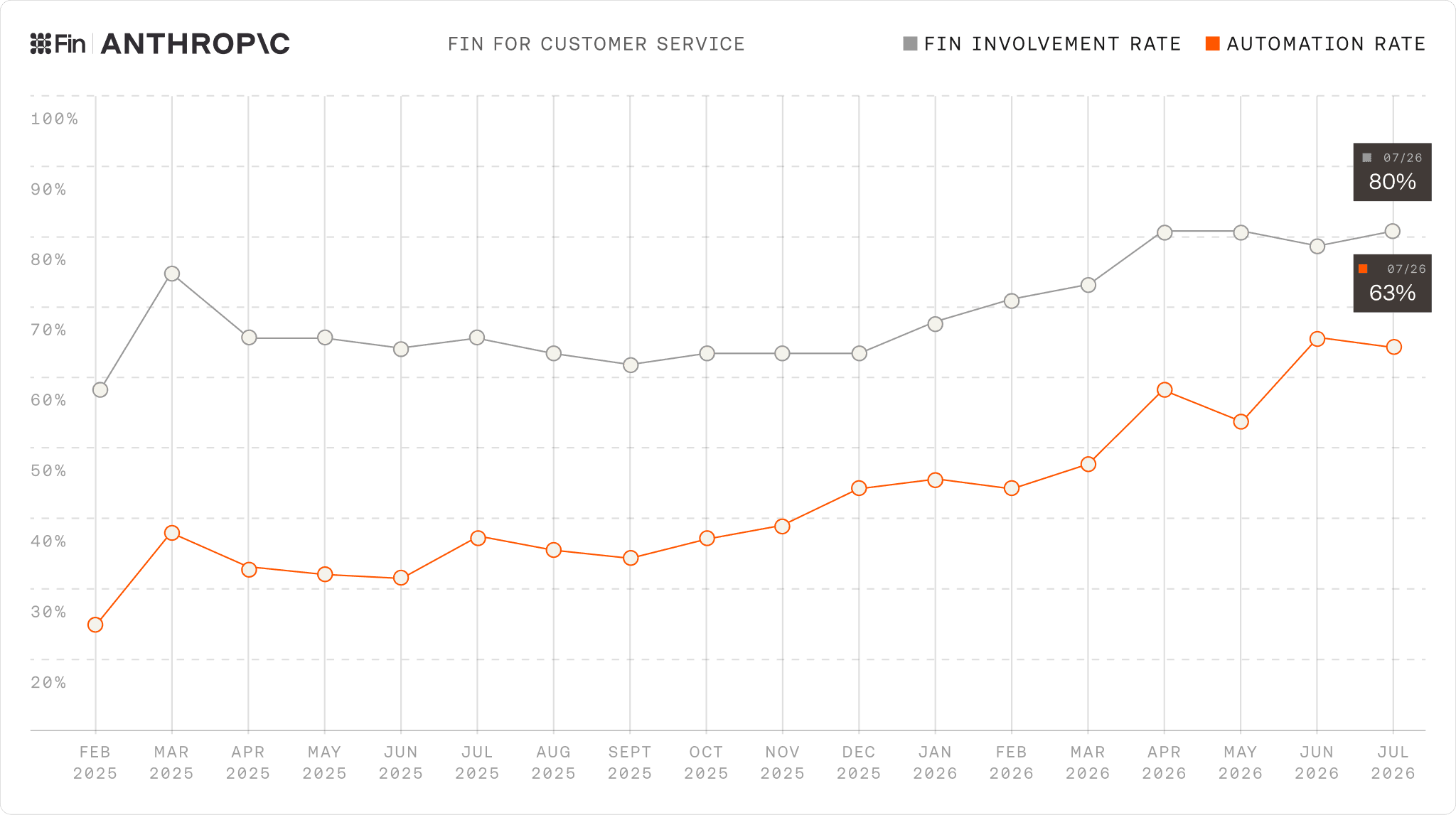
The time that’s been saved has been reinvested in higher-impact activity for the human team. Specialists now focus on the parts of support that require human judgement, like deep enterprise issues, compliance edge cases, and proactive outreach. “Our team is now able to invest in skills they wouldn’t otherwise have time for when they were firefighting large volumes,” says Isabel. “Now they can get deeper with customers and cross-functional teams, and really build out what a successful support career looks like.”
Looking ahead
For Isabel, transformation is not a destination – it’s a process that evolves with the technology and the team.
They’re investing in roles and processes that reflect this approach by hiring AI-literate support specialists, formalizing sprint cycles, and embedding Fin’s performance into team goals.
The team is also continuing to expand Fin’s role in procedural workflows, including tasks like refunds and account changes. They're exploring how AI can support more of the user journey by extending its impact beyond post-issue support into areas like proactive help in onboarding, education, and community.
"Fin has transformed how we support customers at Anthropic but we also see the potential to do so much more,” Isabel shares. “We're experimenting with using Fin in other areas like Sales, and ultimately a move towards a seamless experience for our customers at every stage."
In an industry that moves as fast as AI, Isabel’s approach is grounded but forward-looking – a support model where automation handles scale and predictability, while humans focus on empathy, strategy, and trust.