

At a glance
Salesforce calls itself Customer Zero because it runs its own business on the technology it offers, proving firsthand what will help customers succeed. So when Salesforce acquired Fin, the AI Customer Agent, it set an ambitious goal: have Fin live on help.salesforce.com, a portal that draws 60 million visits a year, on the day the deal closed.
That left 16 days to connect Fin to Service Cloud, have it ingest 167,000 pages of help content, and pass Salesforce’s rigorous testing process.
Bernard Slowey, SVP of Customer Success, and his team treated the launch like any other experiment on the portal. They started with a small share of support chats, tracked every result, and increased Fin’s involvement as it proved itself.
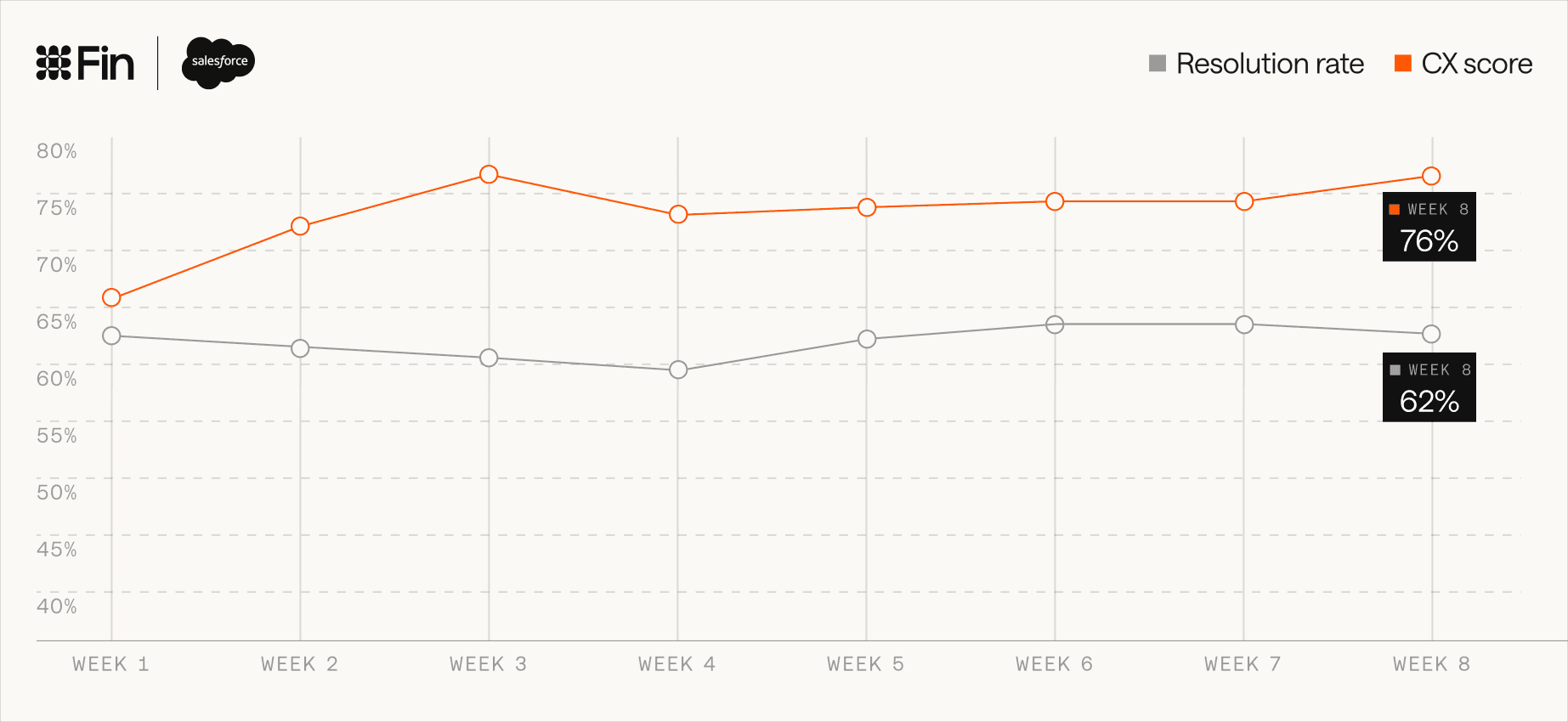
Fin went live on schedule – in just 16 days – and scaled quickly. It’s now involved in half of all incoming queries on the English-language portal and resolves 62% of them, while Fin’s CX Score, a measure of conversation quality, has held steady at around 76%.
We are all in on Fin.
From November 18, Fin will handle every conversation on the English-language portal. Salesforce then plans to take Fin further, across more languages, new support channels, and other stages of the customer journey. Here’s how the team got there.
Salesforce’s own AI support journey
Salesforce is the world’s largest CRM provider, with more than 150,000 customers running their businesses on its products. Those customers use more than 80 product lines, and when they have a question, help.salesforce.com is where they start. The help portal sees 60 million visits a year, with customers coming to it for everything from quick how-to questions and complex troubleshooting to onboarding, billing and renewals, and requests to reach a support engineer.
For the past two years, Salesforce’s Customer Success team has been working out how AI can give every customer a fast, accurate answer at the volume the portal handles. Along the way, the team learned that the right answer is only half of what constitutes great service. How the interaction makes a customer feel matters just as much. The acquisition of Fin gave the team a new way to deliver both.
Bernard set his team a bold target: have Fin live on help.salesforce.com, in front of real customers, on the day the acquisition closed. That meant moving faster than most enterprise deployments, on one of Salesforce’s most visible surfaces, while still making sure every change was right for customers. “At that scale, you find the edges of your deployment incredibly fast and often very publicly,” notes Emily Winslow, Salesforce’s Senior Director of AI Products and Customer Success, and one of the managers of the rollout.
Getting Fin live in 16 days
The deadline was tight, and some inside Salesforce doubted it could be met at all. Bernard’s team and the Fin team worked as one to prove otherwise. “We can’t afford not to experiment,” says Emily. “So when we think about something like Fin on that portal, we ramp up like we would with any other experiment that we’re doing.”
The plan was to start small, with a focused set of use cases and a limited share of traffic, then increase coverage step by step as the results came in. Before launching, the groundwork had to be in place:
- 1Knowledge content
The team trained Fin on 167,000 pages of help documentation with zero custom code. “We literally just gave it the URLs that our content sits on, and Fin was able to ingest that content straight away,” Bernard says. From day one, Fin could answer how-to and troubleshooting questions across the full product range. It rechecks every page each day, so its answers stay up to date as articles change. - 2Helpdesk integration
Fin connects directly to Salesforce’s customer service platform, Service Cloud, so cases and skills-based queues stay where they are. “It integrates incredibly well with Service Cloud,” says Bernard. “It honors all of our existing routing and works out of the box.” When a customer needs more help, Fin hands the conversation, with full context, to a support engineer in the system the team already uses. - 3Single-workspace setup
Salesforce tests every change in three sandbox environments before it reaches the live portal, and all four connect to a single Fin workspace. The team builds content, guidance, and procedures once, tests them in each sandbox, and pushes them to production when they’re ready. One piece of work carries across every environment, and every change follows Salesforce’s own release process. - 4Quality assurance
Before any customer saw Fin, Salesforce ran it through 600 test questions covering 85% of its top case drivers and measured the responses against its own benchmarks. Wherever an answer needed adjusting, Bernard’s team could step in and refine it directly. “Guidance is where we coach Fin in natural language, telling it how we want to show up for Salesforce,” he explains.
Fin launched on the day the acquisition closed, right on schedule. “We got Fin live in 16 days with a very nimble team,” recalls Bernard. “And remember, we’re a complex B2B company.” With that foothold in place, the experiment could start to ramp up.
Scaling with confidence
Live conversations were the true test. “There’s no really good replica for customer interactions,” Emily points out. “You can have your internal teams test these agents, but until you see it in the wild, that’s really when you’re going to find out how it performs.”
At Salesforce’s scale, even a small increase in Fin’s involvement brings a lot more volume, and a lot more opportunity to show results. “The impact that we have even at 5% can be a non-trivial volume of customers,” Emily notes. Each stage sent a bigger share of incoming support chats to Fin: 5% the morning after launch, 10% within two weeks, and 20% around week four.
Throughout, the team tracked Fin’s resolution rate alongside its CX Score to make sure customer experience held up as automation grew. They also looked for ways to improve Fin, and much of that work came built in. Fin reviews each chat it couldn’t resolve, flags gaps in the help content, and makes recommendations the team can apply in a click.
My team and I can manage Fin without having to go to admins, which means we can do regular updates, multiple releases a week.
Then there’s Operator, Fin’s Operations Agent. “Operator is probably my favorite feature,” says Bernard.
Operator takes on the work of an analyst, finding where Fin can do better and pointing to the fix, which makes improving Fin as easy as possible. When Bernard asked it, in plain language, “What was my resolution rate last week, and how do I improve it?”, it came back with the conversation topics driving that number and where to focus next.
Every one of those fixes can be shipped by the support team on their own, on their schedule. “My team and I can manage Fin without having to go to admins, which means we can do regular updates, multiple releases a week,” Bernard explains. Improvements reach customers instantly, and that pace gave the team the confidence to scale fast: within seven weeks of launch, Fin was involved in half of the English-language portal’s support chats.
Proof at enterprise scale
In its first full month on the portal, Fin resolved more than 21,000 conversations. “We’re already seeing a 62% resolution rate,” says Bernard. Almost two in three of the chats Fin takes on are resolved without a support engineer stepping in, and the quality of those conversations has held firm.
Fin’s CX Score stayed around 76% even as its involvement grew tenfold. Customers were getting the right answer and a good experience, the balance the team had set out to protect.
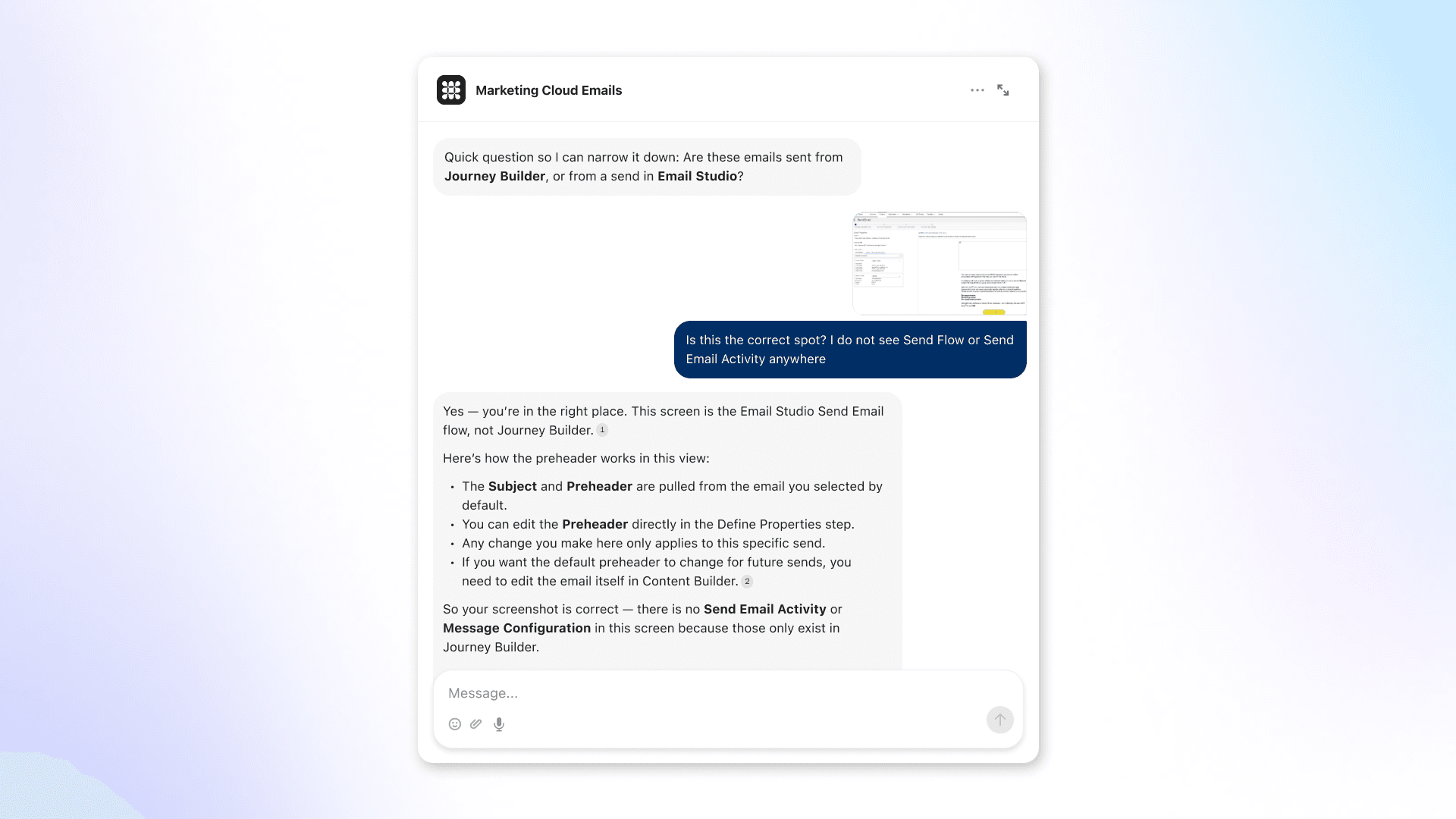
“It’s consumer-grade AI,” says Bernard. “It flows like you’re having a conversation with a person.” Customers can share screenshots, run several threads of conversation at once, and pick up where they left off once they log in.
One recent conversation shows what that looks like. A customer came to the portal because emails in Marketing Cloud were displaying differently from how they wanted. As they worked through the fix with Fin, they shared screenshots over several turns to check they were in the right place in the product. Fin read each image, confirmed they were on track, and guided them to a solution.
What’s next
Emily sees Fin’s first weeks as the foundation for harder work. “Fin immediately took the sheer volume of simpler questions off our support teams,” she says. “We take all of those builders and experts and work on expanding the definition of what’s possible for self-service.”
That means giving Fin advanced troubleshooting skills, access to log files, and customer and account context. With those, Fin can resolve more complex issues on its own, like resetting a user’s password on their behalf. Beyond support, Salesforce also plans to take Fin into onboarding and adoption, helping customers get more from the products they’ve bought.
The technology is ready for that next step. “In the first couple of years of building AI agents into our support process, there was this hurdle of response quality,” Emily says. “For a large part, we’ve cleared that hurdle.”
Within the next few days, Fin’s involvement will expand to all conversations on the English-language portal, around 2.5 million a year. Other languages on the site will follow, starting with French, German, Italian, and Spanish.
The team also plans to bring Fin to more of the channels where customers look for help. That starts inside the Salesforce platform itself, so users can get answers where they work, and extends to voice support in the US and Canada.
And everything Salesforce learns along the way shapes the product, so every Service Cloud team running Fin will benefit too.
“We are all in on Fin,” says Bernard.