
How Personio achieved their biggest-ever drop in human support contact rate during their busiest month
Personio is Europe's leading HR software platform, serving 16,000 companies and 1.5 million employees. With that scale comes a support operation that handles about 40,000 conversations a month in one of the most heavily regulated industries, where customers rely on Personio to manage sensitive employee data, payroll, and recruitment workflows. That volume spikes sharply every January, when annual HR policy resets trigger a flood of questions from employees and admins.
Their previous solution, a search tool with a conversational interface, had done its job. But it was never built for the volume, complexity, or self-serve demands of a fast-growing enterprise product; it couldn't reason or handle questions that went beyond what was explicitly written down and lacked robust mechanisms to enforce a high quality bar. They needed an AI Agent that could perform at real volume, integrate into Personio app, and be manageable day-to-day by a small in-house team, and deliver a high-quality customer experience.
Personio evaluated several AI support agents before landing on Fin. One of the strongest contenders relied on a forward-deployed engineering model, while Personio wanted a solution that their small team could own and manage independently, without relying on a vendor for every change. "Their philosophy was to always have an engineer that would do a lot of the stuff for us, when in reality we wanted a tool that was simple enough for us to control, configure, and maintain over time," recalls Alessandro Presa Perez, CX AI Operations Lead at Personio.
Fin's self-manageable approach won that argument. So did the partnership. “What made a big difference was having Fin's own support team sharing their knowledge – people who run their own support org with Fin every day, sharing what works and how to think about building for AI-first support. That was by far one of the biggest weaknesses in the other vendors. The other vendors never thought beyond the technology.”
 “I don't know how we would have done this without Deployment Services. The value went far beyond implementation, they helped us rethink processes, ownership, and how we operate in an AI-first support model.”
Personio's deployment wasn't straightforward either. Rather than embedding a standard chat widget, they wanted Fin to live inside their own product, so when a Personio customer clicks "get support," they stay within the Personio app. Fin’s Deployment Services team worked shoulder-to-shoulder with Personio's engineers to make it happen, navigating every technical curveball along the way. "I don't know how we would have done this without Deployment Services," Alessandro says. “The value went far beyond implementation, they helped us rethink processes, ownership, and how we operate in an AI-first support model.”
Personio went live ahead of the seasonal spike. "We wanted to deploy by January because that's when we see the biggest spike in volume, and it was really important that we met that deadline," says Alessandro. “We managed to do that with Fin, and we started seeing results pretty much straight away.”
“We had assumed we'd be in the 60 to 70% range. We frankly did not anticipate how well Fin would perform.”1. Increased efficiency
The Personio team saw fewer customers needing to reach a human agent, with Fin resolving issues that would previously have landed in the support queue. The global human support contact rate dropped 25–30% in Q1, and in the SMB segment, where all customers must go through Fin before reaching a human, the drop was 40–50% year over year. Fin now resolves around 80% of all conversations, well above what the team had scoped for. "We had assumed we'd be in the 60 to 70% range," Alessandro recalls. "We frankly did not anticipate how well Fin would perform."
2. Better customer experiences
Personio serves two types of users inside each customer organization: the HR teams that manage the platform, and the employees who use it day to day. Before Fin, HR admins were the only ones who could reach support directly, while other employees within the company typically had to route questions through their HR team. Now, employees can get immediate, accurate answers themselves, whether they’re working out how to log hours against a project, checking a leave balance, or navigating a new HR process. "For the first time, support feels accessible to everyone in the organization. Employees can get answers themselves instead of waiting on their HR admin, and HR teams deal with far fewer interruptions. Win-win for both," Alessandro says.
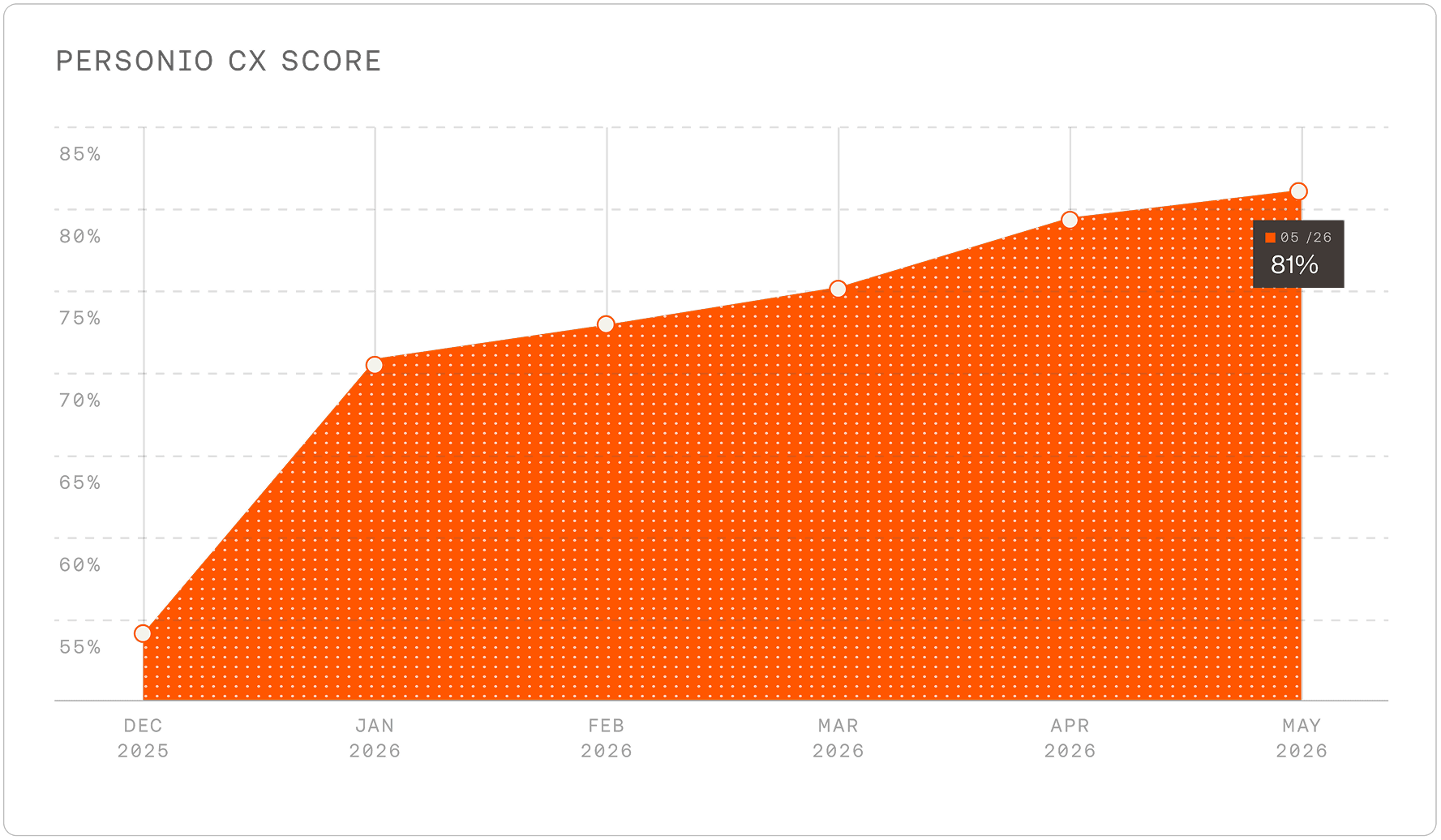
That shift showed up in Personio’s CX Score – an AI-rated measure of answer quality across every conversation. As customers started getting instant support without leaving the Personio product, the CX score climbed from 54% in December to 71% during their busiest season, and has since held around 80%.
3. Full visibility across the user base
Fin also unlocked something Personio hadn’t had with its previous solution: visibility across the entire user base. “Before Fin, we couldn’t clearly see where customer experience was breaking down. Now we understand where the problems are and why,” shares Alessando. “Fin surfaces where we’ve massively under-documented product behavior, where product limitations are generating volume, and where our internal processes need to improve”
With January behind them and Fin resolving 30,000 monthly conversations, the team is now focused on building Procedures, enabling Fin to automate more complex, multi-step workflows like permissions and access troubleshooting.