At a glance
London South Bank University (LSBU) was receiving a growing number of inquiries from its students. With the requests coming largely over email and the phone during business hours, the customer service team was dealing with an overnight backlog of queries every day.
The world now expects 24/7 connectivity.
When Adrian Tucker, Director of Digital Transformation, joined LSBU, one of the things he was tasked with was improving the digital journey for students and creating a conversational search tool that would give students support 24/7. “The world now expects 24/7 connectivity,” he explains.
To solve this, Adrian’s team looked at a number of tools and spoke to Fin, the AI Customer Agent, and connected it to the university’s Salesforce Service Cloud setup. Seven weeks later – ahead of the important clearing period, the universities' busiest admissions window – ‘Ask LSBU’ (Fin) went live. In its first month, it resolved 87% of the chat conversations it was involved with, proving its value and becoming an important part of how LSBU supports its students.
Here’s how they did it.
Student support limited to opening hours
LSBU is a university in London with more than 15,000 students from over 130 countries. Supporting those students through their exams and helping address any concerns about accommodation and what comes next for them is important to ensure they get the most from their studies.
Our focus was getting less complex answers to our students in the quickest possible time, allowing them to get back to their studies and their life.
A student with a quick question about enrolment or timetables would call the customer service team or send an email. After hours, students could use the website search functionality to look for an answer themselves in LSBU’s knowledge base, or chat with an older chatbot that could return basic responses. If neither of those options provided the comprehensive answer that students needed, they would typically wait to call during office hours, or send an email and await the reply.
Adrian’s brief was to make the process smoother and the university’s behind-the-scenes systems more efficient. Customer service was the obvious place to start, acknowledging that some queries need a human in the loop, while others could be answered quickly. “Our focus was getting less complex answers to our students in the quickest possible time, allowing them to get back to their studies and their life,” says Adrian. “That’s all about not having queries and questions burning away in students’ minds.”
Finding the right AI solution
Adrian saw AI as the answer. In his search for the right vendor, he prioritized two things:
- 1The AI Agent had to improve how students got help.
- 2It had to work with the university’s existing Salesforce Service Cloud setup to make things as seamless as possible for the team.
Adrian began by assessing what was already in LSBU's tech stack, but nothing offered the functionality or fast deployment he wanted. Having that clear link with Salesforce and a proven track record in conversational dynamics were vital.
Not wanting to risk the student experience, Adrian expanded his search across the market, and that’s when he looked at Fin. It met his integration requirement in that it could connect directly to Salesforce, sync the university’s existing knowledge articles, and follow its case rules, allowing reps to keep working in Service Cloud as they always had. Adrian started talking to the Fin team, and together they agreed on a pilot to prove that Fin could answer students’ questions accurately, take volume off the service team, and provide 24/7 support.
Going live with Fin in time for clearing
As the work got underway, Adrian was clear that Fin would need to deploy ahead of clearing due to a change freeze. This meant deployment in seven weeks. Clearing is the UK admissions window after exam results come out, when universities fill their course places and students without an offer apply directly. It brings LSBU more questions from prospective students than any other point in the year, so going live for clearing would give Fin the best opportunity to prove itself.
For the pilot, the team planned to have Fin sit in the chat on LSBU’s external website, helping prospective students by drawing on the university’s public web pages and Salesforce knowledge articles. Fin would also appear on the internal Library pages to help returning students. To make this happen, the small team had to focus on getting four things right:
Launching with accurate, well-structured content
An Agent is only as good as the knowledge it’s given, so the customer service team, marketing and Adrian’s Digital team spent a lot of time checking LSBU’s existing content. Reviewing how information was structured surfaced pages that were hard for Fin to use. The university’s professional short courses, for example, sat on pages with identical titles, so Fin struggled to tell one course from another. Once the course details were supplied in a structured format, answers about those courses improved sharply. “You have to put the miles in on the content. The tool can only be as good as the content,” says Adrian. “When answers were wrong, the tool was inevitably suspected. Was it hallucinating? But once we investigated, the majority of the time the content was the issue.”
Connecting Fin to Service Cloud
LSBU’s Salesforce team worked closely with Fin’s engineers on the technical side of the build. “There was some back-end work that needed to be done, like was Fin creating the cases? Was it handing off properly?” explains Adrian. With few people to spare, his Salesforce product owner moved onto the Fin project for a period to see it through.
Testing at volume
Testing ran alongside the build. The customer service and library teams asked Fin nearly 1,500 test questions and checked every answer against how a human rep would respond, so they knew it was correct, while the digital team made sure Fin drew on the right sources.
Confidence grew gradually, and when the idea of launching to a small group first came up, Adrian pushed back. “I said, the key focus of the project is to see if we can handle volume, and the only real way to test that is by driving volume,” he recalls. “With all the testing that had been done, the decision was to launch to a wide audience.”
Launching ‘Ask LSBU’
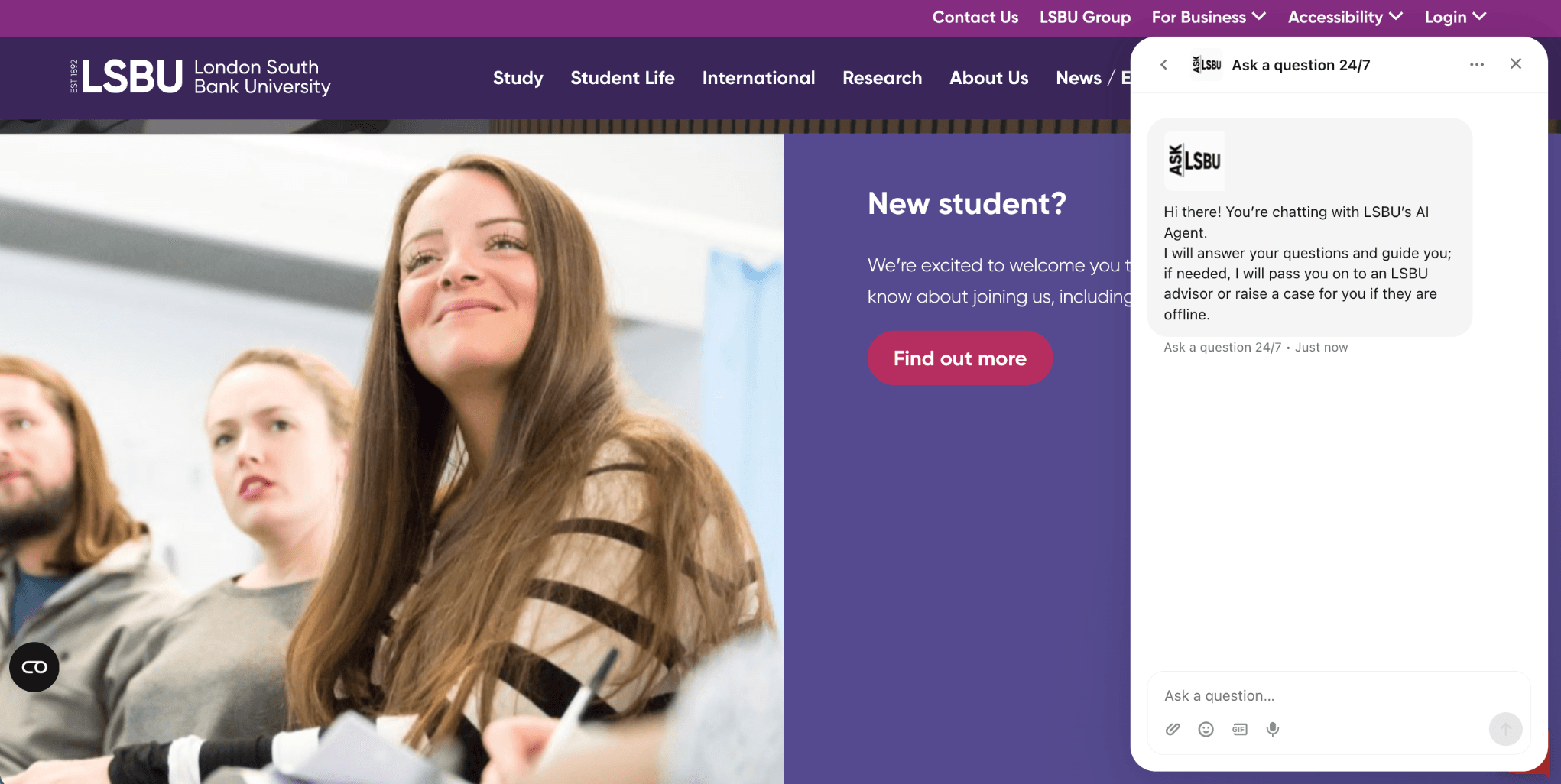
Adrian wanted students to see the Agent as part of the university from day one, so he named it ‘Ask LSBU’. The team customized the messenger to match the university’s look, and shaped how Fin presented its answers. “It feels LSBU, it looks LSBU,” says Adrian. “It's now part of the stable, as opposed to a bolt-on.”
The build and subsequent launch went to plan. Fin went live seven weeks after work began, just in time for clearing.
From pilot to permanent part of the support team
Initially, the team had discussed reviewing Fin’s performance during the pilot after a few weeks. However, they quickly decided that it was worth making the Agent a permanent part of the team. “Within days, it was very clear to me that we hadn’t delivered a proof of concept at all,” says Adrian. “We'd delivered a product, and it was working.”
In its first month, Fin resolved 87% of the chat conversations it handled. Students got answers at any time of the day, whether they were reaching out during business hours or in the middle of the night, in any language. “We pride ourselves on being a multicultural university, so the fact that Fin is genuinely multilingual was a nice surprise and not an expected feature,” mentions Adrian.
Within six weeks of going live, Fin had handled more than 3,000 conversations. “There are lots of examples where students say to the agent, ‘Thanks very much, that’s all I need to know,’” notes Adrian. When a student does need a person, Fin passes the conversation to the team in the Salesforce Service Cloud, with the full context carried over so the reps don’t have to ask the student for the same details all over again.
Fin’s reporting also helped the team improve the students’ experience. By automatically grouping every conversation into topics, it showed that student questions follow the rhythm of the year and vary according to where they’re at in their studies. Returning students, for example, ask different questions from new ones, like what their results were, or when timetables will be out. The team uses this data to refine the content or talk to their student teams about common questions. “Ask LSBU is great, but we should also ask why students need to be asking certain things at all,” says Adrian.
Fin phase two and beyond
“This isn't the end,” remarks Adrian. Fin only has access to certain parts of the content and is not yet fully agentic. LSBU has a multi-phased plan to evolve and improve the Agent.
For example, the next phase will let students sign in, so Fin can answer questions about their own academic journey. "Today, if I ask where I get my timetable, Fin will say, 'Log on to your account, and this is where your timetable will be,'" explains Adrian. “In phase two, the plan is for Fin to return the specific student’s timetable and also tackle other enquiry volumes that the agent can't yet see.”
LSBU is working with a Fin implementation partner to deliver this next stage. That means connecting Fin to Moodle, the learning management system (LMS) where students find their courses and coursework, and to SITS, the new student records system the university is rolling out. With both in place, Fin can answer returning students' questions about their studies and, in time, take action on their behalf.
Beyond phase two, Adrian sees room to grow. Bringing Fin to email and other channels will make it far easier to answer the roughly 10,000 inquiries LSBU receives each month with the same high quality. The LSBU Group’s colleges could follow the university, and Fin could start helping staff too.