
From missed calls to 50-second resolutions: How ParkBee transformed phone support with Fin
ParkBee turns underused private spaces, office car parks, and residential garages into bookable parking spots for drivers across European cities. By opening these spaces to the public, ParkBee helps reduce street congestion and puts idle space to work.
It's a model built entirely on frictionless access. Because these are privately owned locations, there are no on-site staff, which means when a driver pulls up to a parking garage and the entry barrier doesn’t open, everything is tested in that moment. “If you can't enter or exit a location, you damage customer trust immediately,” says Marco Seeleman, Customer Experience Manager at ParkBee. “The only way to gain that trust back is to help them as soon as possible.”
Around 70% of ParkBee's calls came from drivers stuck at a barrier, sometimes with cars queuing behind them. Getting them moving again, fast, was central to making ParkBee local drivers' provider of choice and, in turn, scaling the business.
Today, Fin, their AI Agent, resolves interactions end to end 70% of the time for callers with a valid booking in around 50 seconds, with no human agent required.
This is how they got there.
By 2025, ParkBee's phone support model was straining under its own success. The company was growing 40% year-over-year, operating across the Netherlands, Belgium, the UK, and Germany, with a team of around 20 part-time agents handling 10,000 calls a month.
Call volume was only part of the problem. Demand clustered heavily between 5pm and 7pm and across weekends, exactly when parking locations are busiest and drivers are most likely to be stuck. “Staffing up for just two peak hours would have meant overstaffing the rest of the day,” Marco explains. “That wasn’t practical or sustainable.”
 “Every second you have to wait longer, you lose the trust of a customer.”
To manage overflow, ParkBee used a BPO partner. If wait times exceeded two minutes, calls were automatically routed there and billed per call. The model ensured coverage, but costs scaled directly with growth. And even with the added coverage, response times remained inconsistent. During busy periods, customers could wait up to seven minutes before reaching anyone. “Every second you have to wait longer, you lose the trust of a customer,” Marco says.
With 40% year-over-year expansion, that pressure was only going to compound. Phone support had quickly become one of the company's biggest operational constraints. With trust on the line and costs rising alongside growth, the system needed to change.
ParkBee had already been using Fin over chat, powered by their knowledge base inside Intercom. Setup had been straightforward, results came quickly, and the team had seen firsthand what Fin could do when it had the right information.
“We saw the opportunity with Fin over the phone to help customers in a really stressed moment, really fast.”Extending that to the phone meant offering the same seamless experience across every channel a customer might reach them on. “We were excited straight away,” Marco recalls. “We saw the opportunity with Fin over the phone to help customers in a really stressed moment, really fast.”
The team connected Fin directly to their backend systems, enabling it to handle high-pressure moments over the phone end to end. When a customer calls, Fin answers instantly, verifies their booking in real time, looks up details about their location, figures out the correct barrier to open, triggers it, and confirms the driver is through. Every interaction is logged, giving the team full visibility into how Fin is performing across locations.
“When you connect external systems to Fin to read customer information or act on it, that’s when you really change how you do support. It stops being about answering questions. It becomes part of your operations.”On rare occasions, when Fin can't resolve something on its own (like in the case of a hardware fault or an expired booking) it hands off to a human agent with full context already attached, so they can pick up where Fin left off.
“When you connect external systems to Fin to read customer information or act on it, that’s when you really change how you do support,” Marco explains. “It stops being about answering questions. It becomes part of your operations.”
Fin is now at the front of ParkBee's phone support, handling the majority of urgent access requests before a human ever needs to step in:
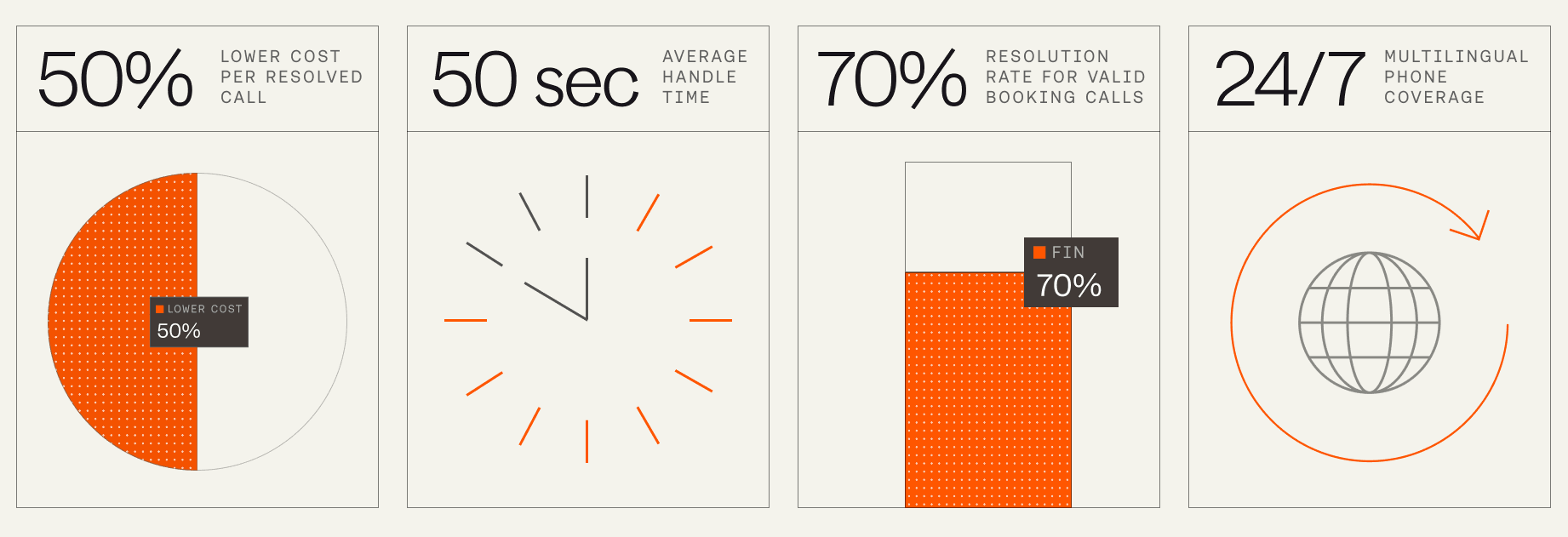
- ~50% lower cost per resolved call: Fin now handles the volume that used to go straight to the BPO, at roughly half the cost.
- 50 seconds average handle time: “For us, the biggest change is speed and availability,” Marco says. “Fin has reduced our handle time by 72%. A call that used to take over 3 minutes now takes less than 50 seconds – a much better experience for our customers.”
- 70% resolution rate for callers with a valid booking: When a driver calls with a valid reservation, Fin resolves the interaction end to end 70% of the time, no agent needed. The 30% of queries that do get handed over involve genuine hardware faults or system issues that would have required a human regardless.
- 24/7 multilingual coverage: Fin’s ability to serve customers in multiple languages means ParkBee no longer faces the same hiring constraints, giving them room to price competitively as they enter new markets. “As we grow across Europe, Fin lets us scale support without building customer service departments everywhere,” Marco says. “That keeps our pricing competitive for customers.”
- Better, faster customer experiences: The shift goes beyond resolution rates and cost savings. For a driver stuck at a barrier with cars queuing behind them, 50 seconds feels very different from seven minutes. Marco regularly listens to calls to understand how Fin performs in real situations. One stood out: “I was listening to a call where you could hear four people in the car,” he says. “They were cheering Fin on. When the barrier opened, someone said, ‘Wow, that was AI. Impressive!’”
For ParkBee, that reaction says everything. Fin is delivering faster, more seamless experiences at the moments that matter most.
Deploying an AI Agent that connects to your systems and takes action over the phone requires confidence you're setting it up the right way. For ParkBee, that confidence came from the product and their partnership with Intercom.
“Our partnership with Intercom is phenomenal,” Marco says. “They became so embedded in our workflows that they could run our customer service themselves. They really take the time to think along with us and suggest solutions we wouldn't have thought of ourselves.”
With Fin handling the majority of urgent access calls, ParkBee is expanding its scope. The team is connecting additional backend systems to automate more complex scenarios, and rolling Fin out across more parking products and entry types. The goal is consistent, instant support across every parking interaction in every market ParkBee enters.
“As we expand across Europe, Fin is how we keep service fast and reliable wherever we operate,” Marco says. “And we can scale that experience without scaling the complexity.”