
At a glance
Delivering a human-centric support experience has always been core to Breathe, but as the team looked to grow their business without growing headcount, delivering that experience at scale became a real challenge.
They didn’t just need speed, they needed a smarter, more scalable way to help customers. One that delivered instant, accurate answers without impacting the quality of their support experience – which led them to Fin, an AI customer agent.
In less than a year, Breathe boosted Fin’s resolution rate from 56% to 82%, all while delivering a fast, human-like support experience that their customers love.
Let’s find out how.
Too many repetitive queries, too little time
Before implementing Fin, Breathe had already laid a strong foundation for a human-AI support experience. The team had built a detailed knowledge base, deployed custom bots, and encouraged customers to self-serve answers to their own questions. But despite all that, most queries still landed with a live agent. “We set up custom bots to provide self-service answers linking to our knowledge base. However, the majority of queries still came through to our support team,” says Russell North, Knowledge Base Manager at Breathe.
We needed a tool to help us manage support queries at scale, but just as importantly, we didn’t want to lose the quality or warmth of the customer experience.
Their biggest challenge? A constant wave of repetitive how-to questions – logging in, navigating menus, managing 2FA. These types of queries were flooding the inbox, even though answers already existed in the help center. That meant agents were stuck answering the same questions over and over instead of focusing on more complex, high-impact issues. “The team experienced many repetitive queries, taking up valuable time and resources on simple how-to tasks and questions,” says Russell. “We needed a tool to help us manage support queries at scale, but just as importantly, we didn’t want to lose the quality or warmth of the customer experience.”
Finding an AI agent that balances quality with efficiency
Breathe didn’t just need automation – it needed AI that could understand context, respond with empathy, and feel like an extension of the support team. That’s why the team decided to roll out Fin.
Here’s how they did it:
1. Getting ISO approval for AI adoption
As a company operating in the HR tech space, data privacy and compliance are critical to Breathe’s operations. Before rolling out Fin, the team needed to ensure that the use of AI technology met their industry’s regulatory standards – especially those related to customer data handling and security. Breathe built a business case detailing how Fin would be used and what safeguards were in place. Once approval was secured, Fin was integrated quickly – and started delivering value from day one.
2. Revamping the knowledge base to train Fin
From the beginning, the team knew that AI would only be as good as the content it could draw from. So they restructured their help center to be clear, consistent, and easy for AI to process. That meant removing GIFs, videos, and screenshots, and replacing them with step-by-step written instructions that Fin could understand. “I put lots of work into our knowledge base initially to make sure that Fin knew how to answer a range of questions about the functionality of our platform,” says Russell. “We saw a big increase in our resolution rate after doing this.”
It was very rewarding seeing the results improve as we optimised our knowledge base for Fin.
But the team didn’t stop there. Every time Fin missed the mark, they reviewed the conversation and created a custom Snippet – a reusable, accurate answer Fin could use next time. “It’s an ongoing initiative. We’re constantly creating Snippets based on chats that land in the support inbox when Fin misunderstood a query,” Russell explains. “It was very rewarding seeing the results improve as we optimised our knowledge base for Fin.”
3. Unlocking new role opportunities
Fin didn’t just improve speed; it reshaped how the support team works. The efficiency gains were so significant that Breathe created a new full-time role to own and grow their AI strategy. “My role as Knowledge Base Manager was created because Breathe saw the value Fin brought to the whole team,” Russell notes. “It gave people time back to focus on new projects and allowed us to give better, more in-depth support to customers who require it.”
This shift gave agents more space to handle complex issues, strategic initiatives, and proactive support, while Fin took care of the repetitive queries – making the team more fulfilled and satisfied in their day-to-day work.
4. Guiding Fin to sound just like Breathe
Breathe didn’t just want Fin to be accurate, it needed to feel like an extension of their team when speaking with customers. So the team turned their focus to Fin Guidance and implemented a set of clear rules to ensure Fin handled each interaction with care, empathy, and the right tone.
Here are some examples of the rules Breathe set for Fin:
- If a customer mentioned a login or 2FA issue, Fin was trained to ask for the affected person’s email – but only if it hadn’t already been provided.
- For sensitive topics like cancellations or pricing, Fin was guided to instantly route the conversation to a human.
- To match the support team’s communication style, Fin was instructed to use British English, skip exclamation points, and reply with a calm, friendly voice. Each message begins with a “thank you,” references the customer’s question, and closes by offering additional help.
- If a customer seems frustrated, Fin is instructed to show empathy and offer reassurance.
“Using Fin Guidance and Fin tone of voice works wonders. It gives customer interactions that personal touch that will boost your resolutions and CSAT,” says Russell.
A smarter, faster support experience at scale
In under a year, Fin transformed Breathe’s support experience, helping the company scale without growing the team, while still delivering the level of service their customers expect.
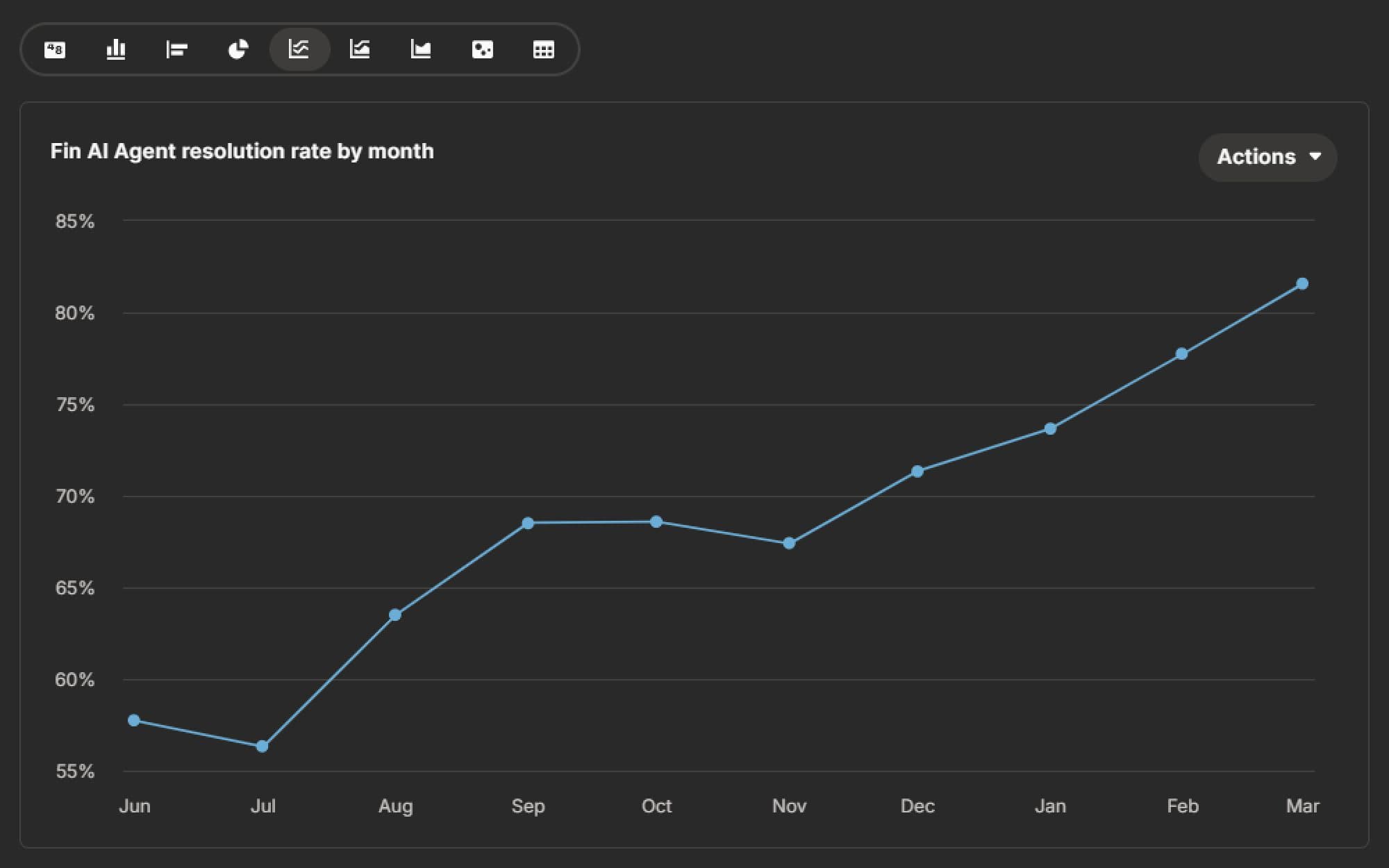
- Fin resolution rate increased from 56% to 82%, achieved in 9 months. When Fin was first implemented, Breathe’s resolution rate sat at 56%. After a few months of knowledge base improvements, snippet creation, and the introduction of Fin Guidance, that number started to steadily grow – hitting 68% by October 2024 and reaching 82% by March 2025. And the team has taken it even further since then, with Fin now resolving up to 88% of queries.
- Fin involvement rate hit 62%: Breathe receives around 7,000 conversations per month, and Fin is involved in 62% of them – resolving the majority. This has taken a significant load off the support team, freeing them up for more strategic and complex customer issues.
- CSAT scores consistently hit 85 – 90%. “Our customers embraced Fin very quickly due to the speed and accuracy of the replies they are receiving," says Russell. “Our Fin CSAT has been very impressive and is now equal to our agent CSAT ratings.”
For Russell, the benefits of Fin come down to two things: first, it’s raised the bar for customer experience, helping customers get fast, helpful answers without sacrificing the human touch. Second, it’s unlocked real efficiency – freeing the team to dive deeper into complex issues and making space for new roles focused on long-term impact.
“Using Fin is a very rewarding job – it’s constantly evolving to boost the customer experience. Watching the metrics improve is the reason I want to go to work every day," Russell shares.
Looking ahead
With Fin now an integral part of their support operation, the team at Breathe has no intentions of slowing down – they’re already thinking about what comes next.
One area Breathe is particularly excited about is AI-powered sentiment analysis. By analyzing real customer sentiment across conversations – and not just relying on CSAT survey scores – it will give the team a more accurate picture of how customers are really feeling. This will enable them to move past one-off scores that reflect frustration with a process, not the support itself, and surface insights the team can actually act on.
They’re also exploring a range of upcoming Fin capabilities. For example, using Fin to complete real steps on behalf of customers – like updating account details or triggering workflows – directly within a conversation, all via API integrations with their existing systems.
“AI has transformed the CX world and it will continue to,” Russell notes. “The best advice I can give is to make sure that the content you have written in your knowledge base or any other content source is the best it can be. This means that Fin’s answers will be correct and you’ll see impressive results straight away.”