Refusing to settle: How Vanta unified its customer experience with Fin
Vanta is one of the fastest-growing companies in security and compliance automation – a category where precision, trust, and speed matter equally.
But as customer volume grew and expectations rose, the team could see that their existing dual-stack support setup – a ticketing system with an AI chatbot on top – wasn't going to keep pace. The AI resolution rate wasn't improving. Coverage was limited. And managing separate tools was making it hard to deliver the kind of consistent, omnichannel experience their customers expected.
To solve this, Margarita Wilshire, Director of Customer Support, and Kelly Bray, SVP of Global Sales, ran a structured head-to-head evaluation and made a decisive call: a full migration to Intercom as their AI-first, omnichannel support platform, with Fin deployed as their front-line AI customer agent. Working closely with Fin’s Product and Deployment teams, they rebuilt routing logic to reflect Vanta's complex, multi-organization customer model, migrated a significant volume of historical tickets, and expanded channel coverage deliberately.
Following the first phase of deployment, Fin is involved in roughly a quarter of all support conversations – and resolves most of them. What started as a way to stabilize a growing support queue is now shaping something bigger: a single front door for every customer question.
Here's how Vanta got there.
In the world of security and automation, trust is everything. This is something Vanta prioritizes in their product and the way their business operates.
“We have our support metrics publicly available on our website for everyone to see,” says Margarita. “Customers and prospects can see our CSAT and how quickly we respond. Our sales team often references that page in conversations, so if anything changes there, I hear about it quickly because it can affect customer confidence and have an impact beyond support.”
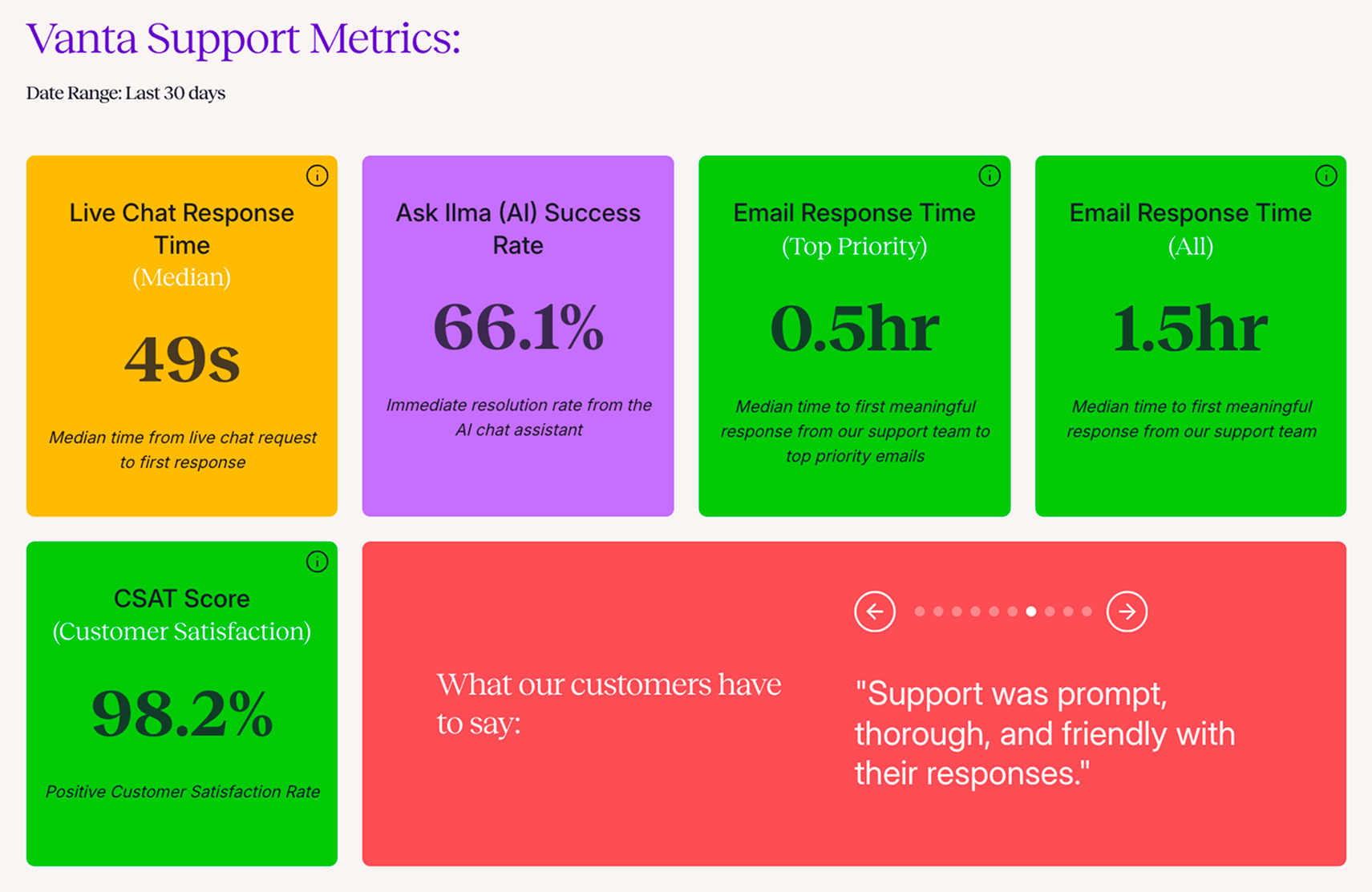
For a while, the team's existing setup held up. But as volume grew and customer questions became more complex, it was clear it was reaching its limits. Their AI was deflecting around 45% of chat conversations, had stopped improving, and had no coverage over email, their highest-volume channel. Behind the scenes, three separate tools were creating the kind of fragmentation that made a consistent customer experience hard to deliver.
 “It felt like we had outgrown the setup, and it was only a matter of time before it stopped holding.”
“Each tool solved a part of the problem, but together they created complexity and made it hard to deliver the kind of seamless, omnichannel experience we wanted for our customers,” Margarita recalls. “It felt like we had outgrown the setup, and it was only a matter of time before it stopped holding.”
Realizing that incremental gains wouldn’t be enough to achieve the outcome they were looking for, the team set off on a structured search for something better. Beyond just better performance, they wanted a long-term partner that could match Vanta’s pace of innovation, simplify their setup, and support the next stage of growth.
Switching support platforms is disruptive. Introducing a new AI agent at the same time raises the stakes further. Vanta knew they needed evidence before committing to anything.
Their Senior Support Specialist, Hannah Nees, ran a detailed and structured head-to-head evaluation using 400 real customer conversations. Fin was tested against their existing AI on resolution rate, accuracy, and answer quality, and resolved roughly 73% of cases. Their incumbent managed around 49%.
“Just seeing the pace at which the team was moving on its roadmap, how it was looking to have Fin do more for us. That's what led us here.”While the difference in resolution numbers was impressive, what really stood out was how Fin handled nuance. It could pull from multiple knowledge sources and successfully navigate more complex questions, make it easier for the team to manage and customize the experience themselves, and follow a clear path to continuous improvement. Fin could also extend automation beyond chat, which is important to Vanta with email being their highest-volume channel.
Then, there was the question of trajectory. “Just seeing the pace at which the team was moving on its roadmap, how it was looking to have Fin do more for us,” says Margarita, “That's what led us here.”
The migration was not a single cutover; it was phased deliberately.
Phase 1: Deliver value immediately with Fin
Vanta didn't wait for a full platform migration to start seeing impact.
First, they deployed Fin within their existing ticketing instance. This allowed the team to introduce AI resolution into their existing stack, while buying time to plan the broader helpdesk transition.
From the start, Vanta worked closely with the team at Fin. They set up weekly and biweekly syncs and a shared Slack channel to iterate quickly on reporting, workflows, and Fin performance.
For Margarita, that relationship was as important as the technology.
“Having a strong partnership was really important to us, especially based on what we had experienced before,” she says. “I cannot name a single person at that previous platform. At Fin, I have a list of names I deal with all the time.”
Phase 2: Full migration to the Intercom
Once Fin had proved itself, the full migration followed. Their ticketing system and existing chatbot were retired. Intercom helpdesk became the system of record, with Fin deployed front-line in the Messenger. A large volume of historical tickets was migrated alongside 700+ help center articles. Routing logic was rebuilt to reflect Vanta's multi-organization customer model, escalation paths were redesigned, and custom handoffs from chat to email with data connectors were built. AI expansion was careful and deliberate at every step.
Phase 3: Expand channels thoughtfully
The rollout followed a clear channel priority and is still ongoing. Chat came first. Email is next, and being approached carefully to increase efficiency, while protecting the responsiveness and quality customers already expect.
The team is also testing Slack as a native channel for a specific use case, with controlled triggers such as emoji responses activating Fin answers. This allows internal teams to leverage AI within cross-functional workflows.
Beyond channels, the team is testing headless “Fin via API” to unify Vanta’s in-product Agent and Fin into a single, coherent AI experience. Early work has also begun deploying Procedures across two complex areas with historically lower AI resolution rates to create a more conversational, personalized, and consultative support experience. Early results are promising, with deflection increasing from nearly 0 to 55%, and handed-off conversations maintaining a high CSAT of 94.1%.
Vanta had set a 50% resolution rate target. Within months of going live, they were outperforming those expectations and redefining what great looked like.
“We are crushing it every month,” Margarita says. “My boss said, ‘I think you should change your metric.’ Now, the stakes are higher.”
Today, Fin fully resolves 71% of the chat conversations it's involved in – nearly 2,500 each month that never need to reach a human.
A new way of working
Bringing Fin onboard has changed what work looks like for the Vanta team: with more manageable queues, follow ups have become faster and more substantive, and reps have capacity to invest in proactive improvements, rather than just keep pace with demand. They’ve also created a dedicated AI Optimization Specialist role, filled by Elli Neeld, to manage and coach Fin with the same rigor applied to any team member. That’s freed everyone else to go deeper with customers navigating audits and compliance reviews.
“Quality is top of mind for us,” says Kelly. “That's really where we see the Optimization Specialist coming into play, making sure that we are watching and coaching Fin in the same level and regularity that we would an employee within the team.”
Memorable customer experiences

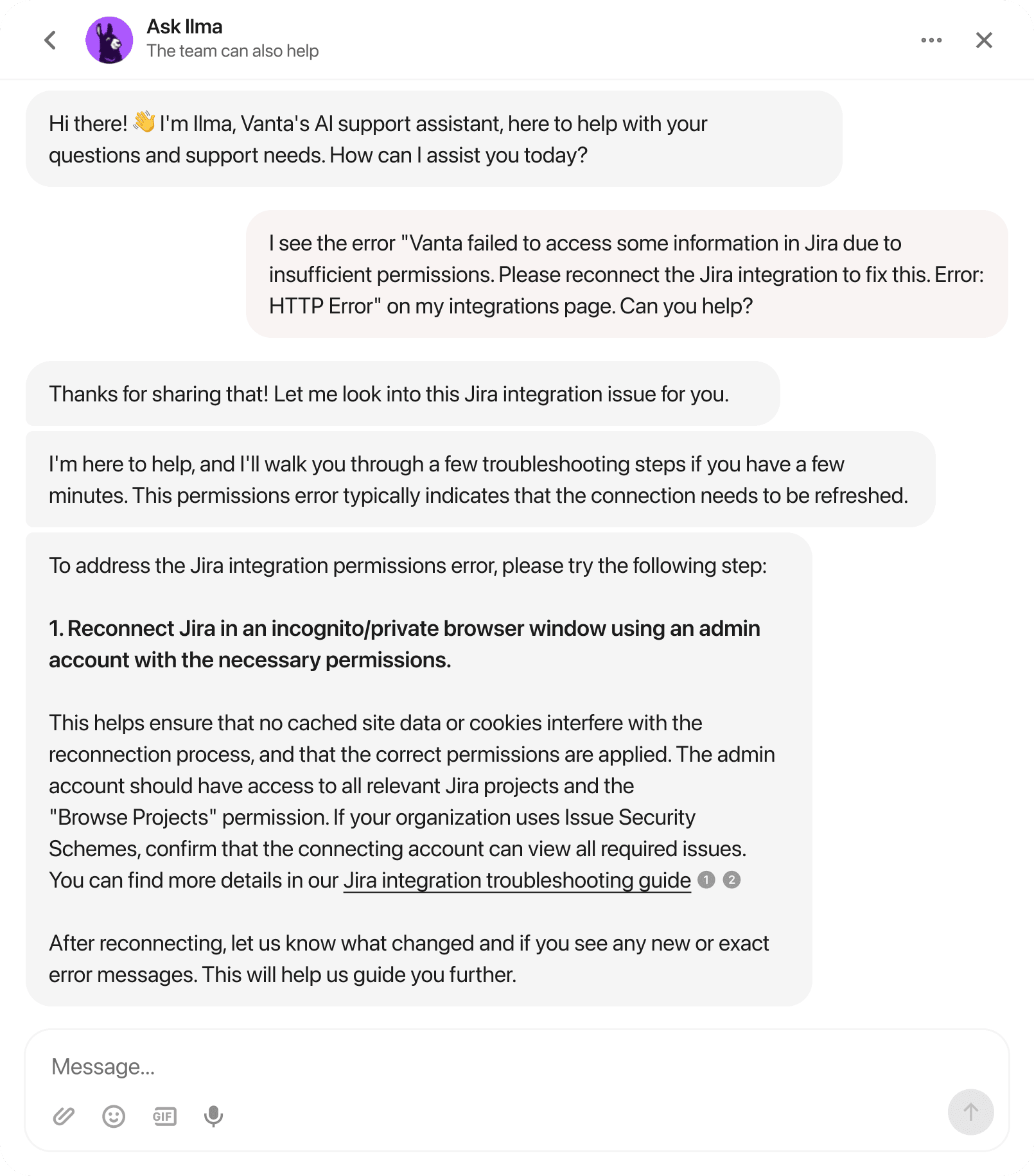
Vanta named their Fin instance “Ask Ilma”, after their instantly recognizable llama mascot. The feedback from customers has reflected something different from traditional chatbot reactions.
“This is the first time ever that an AI chat resolved a technical issue I was troubleshooting.”
“Our team is constantly impressed with Ilma. Best support bot we’ve ever used.”
It's a small detail that reflects something bigger – customers aren't just getting faster answers, they're having experiences worth talking about, evident in Vanta’s 96.7% CSAT Score year to date.
At a recent leadership review, Vanta's support team was named the company's gold standard for AI implementation. For Kelly, that recognition proves that the transformation happening in support is just the beginning.
She oversees support, customer success, and account management – and the shift to AI-first operations has started to change how those functions relate to each other. The question she's working toward is a simple one: why should customers have to figure out where to go?
“I love the idea of a single front door,” she says. “One place for customers to go with any questions. The cognitive load of deciding which questions to bring where should not be placed on our customers – it's on us to design a simple, streamlined customer experience.”
“We are shifting from AI adoption to AI orchestration. AI becomes the core infrastructure that resolves, routes, and learns – not just an add-on.”This is where Fin’s role has potential to expand. What started as a frontline support agent is now being evaluated as a broader customer interface. At a recent offsite, the question was simple and direct: “Can Fin answer all of our downmarket questions?” Much of that work today still follows a familiar pattern, as Kelly describes it: “They get the question, they go research the answer, they bring back the answer. That feels very appropriate for AI to be doing.”
The goal is not to reduce the role of human teams. It’s about changing what they spend their time on, and raising the level at which they operate. As AI takes on repetitive, research-heavy questions across support and customer success, Vanta’s teams can focus on creative problem-solving, strategic guidance, and deeper partnership. As Margarita puts it: “We are shifting from AI adoption to AI orchestration. AI becomes the core infrastructure that resolves, routes, and learns – not just an add-on.”
What started as a way to stabilize a growing support queue has become something much larger. The single front door is no longer a concept. It's what comes next.