Supporting hypergrowth: How Glean put Fin at the frontline
Glean is one of the fastest-growing AI companies in enterprise software. It plugs into everyday work tools like Jira, Confluence, GitHub, Google Workspace, and internal knowledge bases to give every employee an AI assistant for finding information and getting work done faster.
Glean supports two types of users:
- A small group of platform administrators who manage Glean within their companies’ setups.
- Everyday users within companies who use Glean daily to search, ask questions, and run workflows.
In the early days, Glean only provided direct support for administrators. Everyday users directed their queries to their company’s admin, who could create a Zendesk ticket through a gated email-based intake form and/or chat with Glean’s support team through shared Slack channels.
 “We’re an AI company, so we knew we needed an AI-first solution that could move fast, was easy to implement, and would scale with us.”
However, as Glean scaled and adoption accelerated across teams and use cases, it quickly became clear that this model was unsustainable. Glean urgently needed to find a way to support all their users without needing to tear down their existing setup.
“We’re an AI company, so we knew we needed an AI-first solution that could move fast, was easy to implement, and would scale with us,” says Kat Crichton, Manager of Technical Support at Glean. “We wanted something as forward-moving as we are.”
This led them to Fin, the AI Customer Agent.
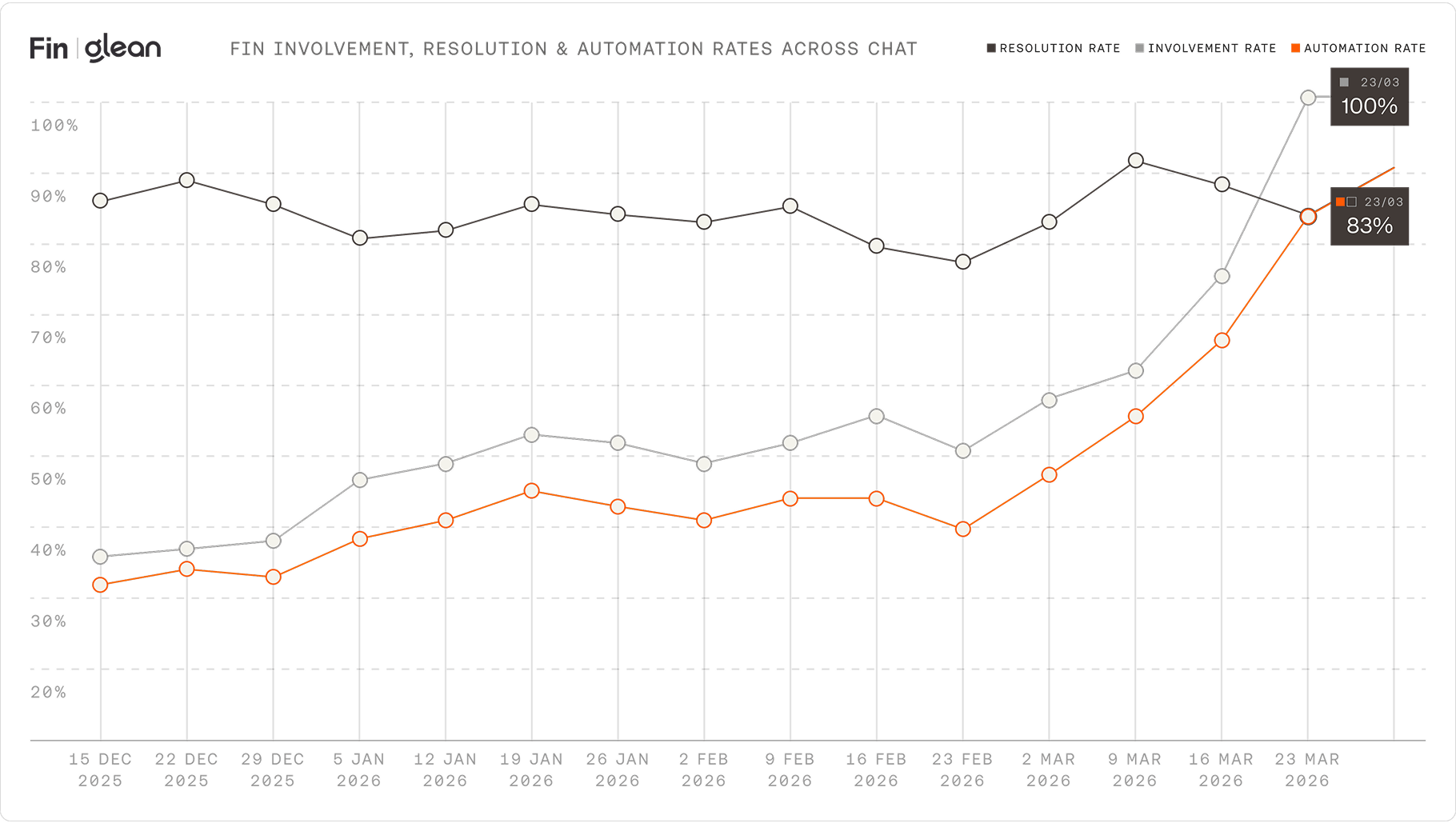
Three months after launch, Fin was supporting all Glean users, handling 100% of chats across the help center, developer docs, Gleaniverse community, and support portal; 83% of these chats were resolved by Fin without a human needing to step in, with a high customer satisfaction rate of 95%.
Here’s how they got there.
As an AI tool that lets users find and understand information, create and summarize content, and automate workflows, Glean’s customer base surged rapidly as enterprises rushed to adopt the technology.
“Glean is a pretty complex solution and our product lifecycle is very fast. Everyday users need help with connectors, data freshness, and the workflows they build inside Glean.”Glean’s support model had been set up to help two types of users:
- Platform administrators: designated owners within a company who manage Glean’s setup (configuring connectors, managing data sources, and overseeing the platform). Because they own the technical environment, these users could create Zendesk tickets through a gated email-based intake form and chat with Glean’s support team through shared Slack channels.
- Everyday users: a much larger group of people within an organization who use Glean to perform their work – whether that’s running a search, querying information, or automating workflows. If an everyday user needed support, their only option was to ask their internal administrator, who would then raise it with Glean’s support team on their behalf.
As the number of users grew, two things quickly became clear: growing headcount at the same rate as the customer base was not sustainable, and they needed a new way to support all their users at scale. More customers meant more everyday users needing help, which in their setup, meant increased pressure on administrators to act as the go-between.
“Glean is a pretty complex solution and our product lifecycle is very fast. Everyday users need help with connectors, data freshness, and the workflows they build inside Glean. The only people who could get help from our support team were administrators,” Kat recalls. “The rest of our users had no way to get answers on their own.”
The team knew they needed a solution fast, so they turned to AI.
Glean went looking for an AI agent for customer service. The obvious move would have been to turn to Zendesk. They were already using it for their ticketing system, and, like most legacy helpdesks, it was offering new AI features. However, Glean didn’t feel like Zendesk could keep up with what they were looking for. “I knew Zendesk’s limitations, and that’s why I wanted something a little fresher and a little newer as our AI support Agent,” shares Kat.
The requirements were simple: an AI-first solution that could easily integrate with their existing setup and handle their complex product and nuanced support model, powered by a provider that innovates at the same rapid speed as Glean.
Fin ticked everything on this list. “Since we’re both from AI-forward companies, we have a very similar mindset in how we want to approach scalability and customer support through AI,” Kat says. “It just feels like we’re one team.”
Within weeks, Glean had Fin live across every public instance its users interact with.
“What really stood out to me was how easy Fin was to use, how quick I could get it up and running,” Kat says. “The UX was fantastic. It was a very fresh build, easy to understand and use, and it just fit well into our current tech stack.”
The team was also excited about how seamlessly Fin was able to support their two different user types:
- Everyday users could ask questions via chat on the website and get personalized answers instantly, without having to go through their administrator.
- Admins could also chat to Fin on the website, and, when they needed to raise tickets for Glean’s support team to investigate, they could send these directly through the chat too.
“From day one it felt like they were part of our team. They knew our product, understood the complexity of what we needed, and helped ensure that only our administrators could file tickets through Fin.”Configuring this so that only admins can create tickets through Fin required hands-on support from Fin Deployment Services. They worked closely with the Glean team to build a custom API integration between Fin and their helpdesk solution that enforced this logic. “From day one it felt like they were part of our team,” Kat reflects. “They knew our product, understood the complexity of what we needed, and helped ensure that only our administrators could file tickets through Fin.”
When Glean first launched Fin, it was involved in ~40% of chats, resolving 80 - 90% of those chats right out of the gate. “People were getting the right answers from Fin, and that built trust to expand further,” Kat says.
It didn’t take long to involve Fin in 100% of chats. Even after expanding its involvement so substantially, Fin’s resolution rate remained steady – now automating 83% of all chat conversations without needing a human to step in.
The numbers alone are impressive, but what mattered most to Glean was how the new experience felt for customers. “A great customer experience was one of the biggest things I was focused on in rolling Fin out,” says Kat.
To make sure they’re measuring quality holistically, Glean looks for:
- How customers rate their own experiences (CSAT).
- How Fin evaluates answer quality across every conversation (CX Score).
Across both metrics, Fin was delivering the kind of experience Glean was proud of: a 95% actual customer-rated score and 75% CX Score.
To top it all off, Fin makes it easy for Kat to surface the results, and even suggests ways to drive improvements in the metrics that matter most.
“I have been living in reports most of my career,” Kat says. “Reporting is super painful in Zendesk, while Fin makes it very easy to drill into the insights I need. I get actionable insight on how to improve Fin and team performance, and I can spin up reports for leadership very quickly. Topics Explorer, for example, lets us see what topics our customers are asking about a lot, and spot areas where I can update our documentation or give Fin specific guidance on how to approach those scenarios. With CX Score, we’re able to show not just a deflection rate or an automation rate, but also the quality of the answers our customers are getting, across all our conversations, not just the ones that customers want to provide feedback on.”
Better documentation leads to better answers. Better answers build more trust. The cycle compounds the more Fin takes on.
Seeing such success with Fin has given the Glean team room to rethink how they operate. Kat, for example, previously oversaw customer experience operations, and much of that work is now handled automatically by Fin. “It was a huge unlock for me,” she shares. “A lot of my time was spent on things that Fin now does automatically. That freed me to uplevel our team, coach our support agents, and move into a new leadership role.”
Kat now leads technical support for Glean’s US West region. “A lot of people are concerned about being replaced by AI,” she says. “We haven’t seen that. AI helps take away a lot of the noise and allows my engineers to really focus on deep diving and solving hard, complex problems – and advance in their careers as well.”
What started as an AI agent rollout quickly became something more. The pace of innovation, depth of reporting, and hands-on partnership set a new standard for what a modern support stack should look like. So the team made a bigger move: migrating their entire helpdesk from Zendesk to Intercom.
With everything on one platform, Glean plans to embed Fin into ticketing workflows and deploy it across shared Slack channels used to support administrators.
As Fin expands to more surfaces, the team is also exploring features that help maintain a high-quality experience across every conversation. “I’m excited to play around with Monitors and Scorecards,” Kat says. “Some of our customers are highly regulated and need very focused, compliant-related answers, so being able to monitor how Fin handles those is important. Our product lifecycle is on hyperscale, so monitoring launches and making sure Fin’s responses stay accurate is a major unlock for us.”
For a company that builds AI for work, choosing Fin was a statement about what best-in-class AI-powered support should look like. Now, paired with Intercom, they can build a support operation as fast and forward-thinking as Glean itself – and take their customer experience even further.